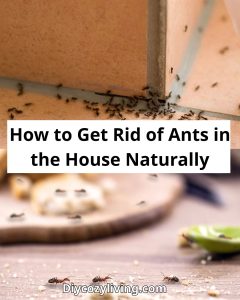
How to Get Rid of Ants in the House Naturally

They make a beeline for the kitchen every summer, come what may. I can never put my finger on when it starts or which one of them is the scout that deems our kitchen worthy of a report.

But by June, once the heat has set in for good, you will spot an ant or two on the counter by the fruit bowl. Before long there is a whole line of them going about their business with the kind of self-assurance that tells you the colony has already made up its mind.

We are used to this sort of thing in the garden; ants in the soil or around the dining table and any sweets left out for five minutes too long. You can put up with it out there. Not so much in here.

I have put down the chemical sprays but they are only a temporary fix. The ants are gone in an instant, then reappear from another angle a week later as if they had a conference on how to get around your spray.

And the odour lingers in the room for days, which I don’t care for in the place where we put together our meals. Lately I have been on the hunt for something more effective that doesn’t involve chemicals. I was taken aback by some of the options, most of which were in the house all along.


Why they come in the first place

instagram.com/sevinbygardentech

You should get a handle on this before you go about fixing it. For the most part, ants have only two reasons to be in your home: food and water. In a summer kitchen you will find plenty of both, from the moisture by the sink to any sweet fruit or crumbs lying about. Don’t think it means your house is unclean; it simply has provisions like any other house does and they have made their way in.

They will find an opening, be it a gap in the window frame, under a door or a crack where a pipe meets the wall. The first one you spot is a scout and he is putting down a chemical scent for his kin to pick up. Put him down and another will take his place along the trail. But if you can break that trail you put an end to their communication.

That is the trouble with the kind of surface spray that takes out the ones you can see. You are dealing with the message but not the system behind it so the problem remains.


Start outside FIRST!

Image Credit to pestcontrolmission.com

What you’re doing in here is only tending to the symptoms. The real issue is the colony out there, and if you put a stop to it, the problem inside will take care of itself.

Start with some boiling water. Locate the nest — you’ll see it as a patch of roughed-up ground by the foundation or under a slab. Just pour the water right in. It’s no-nonsense: you’ll put an end to most of the colony, queen and all. Do it for a couple of days in a row and you’re done with it. Hard to beat for something that’s free and gets results.

Then there’s diatomaceous earth. Put it down at any point where they’re coming in and around the outside of the house. It’s a fine powder made from old algae. Ants can’t make it through without their exoskeletons being compromised; they won’t last more than a day or two. You don’t have to worry about it for your family or the dog, and the science is there to back it up. A good dusting along the walls and in the cracks is what you want. Mind you, you have to put it on dry and go back after a rain, since it’s useless when it’s wet.

Do both and you’re not just following a trail in the kitchen, you’re going after the source.


Disrupting the trail inside

mommypotamus.com

Take some white vinegar, mix it with an equal amount of water and go over any surface you’ve spotted ants on. The acetic acid in the vinegar does a number on their pheromone trail. Once that chemical signal is gone, the ones behind it are left without direction and the line falls apart. You’re not killing them, but for the most part, it’s enough to make them think twice.

Do your counters, the route they like to use, the area by the sink, even the windowsills. The odor will be gone in about twenty minutes. Of course, you have to do this over and over when you see them again. It won’t fix the problem by itself, but if you’re also on top of the colony outside, it’ll keep things under control in here.

Then there’s peppermint oil. Put a few drops on a cotton ball and set it down where you know they’re coming in. Ants will shun strong essential oils, so it can put a stop to them at a given spot. Tuck one behind the fruit bowl or on a sill where they show up.

I’ll be straight with you. Whether it’s peppermint, a line of cinnamon or something else, these are good for making a barrier in one place. They don’t do anything to the colony, though. If you have a real infestation, they’re not going to be enough. Use them to back up the more hard-hitting approaches, not in place of them.

The most effective natural method — borax bait

Image Credit to www.wikihow.com/Kill-Ants-Using-Borax

You want to get to the queen and put an end to the colony from within. For that, you can’t go wrong with a bit of borax and some sweetener. I like to use a little sugar in water or even honey; for every part of borax, put in about three of sugar.

Put a few drops in a bottle cap and set it down by the ant line. The workers will do the rest, taking it back as provisions. It’s not an overnight fix, you have to let the bait make its way to the queen, but once it does, the whole thing comes undone.

It’s a lot better than anything you can put on the surface since you’re after the root of the problem. Just be sure to put it where kids and pets can’t get at it. Borax is no poison, but you don’t want them ingesting any of it. A small amount on the trail is all you need, never on a counter or table. If you’ve got a bad case of ants, this is my first line of defense.


Removing what attracts them

Image Credit to https://diamondpestcontrol.co.uk/

You’ll have better luck with any of the above if you’ve put a stop to what’s drawing them in.

Take the fruit, for instance: in the fridge since late May instead of left out on the counter. That one thing has done more for our kitchen than anything else. The bowl is where they spot something to make a fuss over; no bowl and the room is a lot less of a draw.

Then there’s the sugar, the honey, the jam — all of it in airtight containers or put away with a clean jar. In a Greek summer, an open pot of honey on the counter is practically asking for trouble.

Don’t overlook the bin. They’ll go for whatever has made its way to the floor around it, so give it a good wipe from time to time. And the sink. Ants are after water as much as food, so don’t let a damp spot linger.


What about coffee grounds and bay leaves

@miss_ruby35

Ground coffee with bay leaf is a natural insect repellent and very effective. The best thing to do is to use this mixture in places that have mosquitoes, it works perfectly for ants and even cockroaches ingredients: bay leaves ground coffee paprika #clean #cleaning #fypシ゚

♬ sonido original – Ruby

You’ll see these put forward as the go-to solutions, so I’ll be upfront.

There’s the matter of coffee grounds at your doorways. Some will tell you it works, but the proof is hard to come by. If you have some on hand from your morning brew, sure, give it a shot — no harm in it. But don’t count on it.

Then you have bay leaves stashed in the pantry with your dried food. For the most part, that’s just an old wives’ tale. They don’t do much to keep ants at bay. You’re better off with an airtight jar for the pasta and flour.

I’ve left out the ones with little to back them up, no matter how much you hear about them. The ones I’ve put down here are what I’d say are worth your time.


In the garden

Image Credit to moowy.co.uk

The goal outdoors isn’t elimination — ants in a garden are actually beneficial, they aerate soil and manage other pest populations. The goal is keeping them away from where you eat and keeping the colony from becoming large enough to send explorers indoors.

Boiling water into visible nests twice in early summer. Diatomaceous earth around the outdoor table legs. Wiping the table after every meal and not leaving sweet drinks open.

That combination keeps the outdoor situation at a level where it doesn’t affect how we use the garden.


What we actually do

Here’s what I do:

Put out some borax bait as soon as the first of the season shows up in summer to make an example of the colony. If I spot a line of them in there, I’ll give it a good wipe with vinegar to put a stop to it. I also like to have diatomaceous earth running along the outside of the house, and I keep my fruit in the fridge come June.

It’s not about some silver bullet. It’s a matter of putting a few different tools to work where they’re needed.

I don’t have much more to add on that front. But if you’ve had any luck with a particular fix for a hard-to-kill nest or an entry point you put to rest, I’d be interested to hear it in the comments. You can’t really generalize when it comes to these kinds of issues; what works for one home won’t for another.

If you have any questions or comments lemme know in the comment section below and I will be more than happy to get back to you as soon as possible! <3

Until next time,

Stay safe,

Tasos

Moulios Anastasios
Moulios Anastasios

I’m Anastasios Moulios, co-founder of DIY Cozy Living. I enjoy finding creative, practical ways to make small spaces feel warm, stylish, and lived-in. I started this blog with Katerina to share real ideas that make a home feel a little more personal and a lot more comfortable.

Articles: 123

Leave a Reply

Your email address will not be published. Required fields are marked *