
17 Ideas for What to Hang Above Your Couch (Because That Wall Deserves Better)

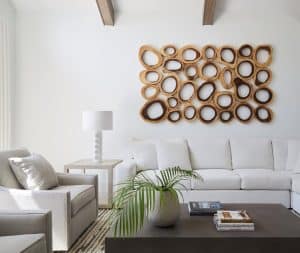
The wall above a sofa is one of the most visible surfaces in any living room — and one of the most often left blank.
I understand the hesitation. It’s a large, prominent space. Whatever goes there will be looked at every single day, by you and by everyone who sits in your living room. Getting it wrong is more visible than getting almost anything else wrong. So people do nothing, and the blank wall stays blank, and the sofa floats in the room like it doesn’t quite belong anywhere.
I’ve been there. Our living room had a bare wall above the couch for almost a year. Tasos kept saying we’d figure it out. We figured it out. And the room finally felt like a room.
These are the seventeen approaches that actually work — from a single quiet painting to a full floor-to-ceiling arrangement.
The Principle First
Before anything goes on the wall, there’s one rule worth knowing: whatever you hang should cover at least half the width of your sofa, and ideally closer to two-thirds.
A small frame above a large couch looks lost. Even beautiful art, hung too small and too centered, will look like a mistake. Scale is the first decision, and it shapes everything after it.
The second thing: height. The bottom of whatever you hang should be roughly 20–25cm above the back cushions. High enough that it reads as wall decor rather than something resting on the sofa. Low enough that it connects to the seating area rather than floating somewhere near the ceiling.
Get those two things right and the specific choice almost doesn’t matter.
One Piece That Does Everything
The simplest solution to a blank wall is one large piece that commands it.
Large Painting as Centerpiece
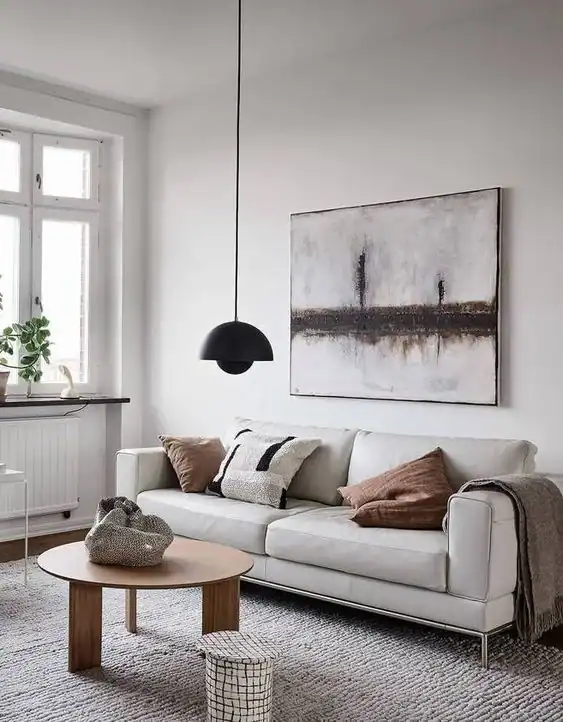
This is the most direct answer to the blank-wall problem, and it works because it makes a single decision instead of many.
A large painting — not a medium-sized one, but genuinely large, the kind that takes up most of the horizontal space above the sofa — becomes the anchor the whole room organizes itself around. Colors in the painting inform what you put on the coffee table. The tone of the image sets the tone of the room.
It doesn’t have to be expensive. Canvas prints and large-format digital art prints can be ordered affordably and framed well. The investment is in scale, not necessarily in the art itself.
Maximalist Muse
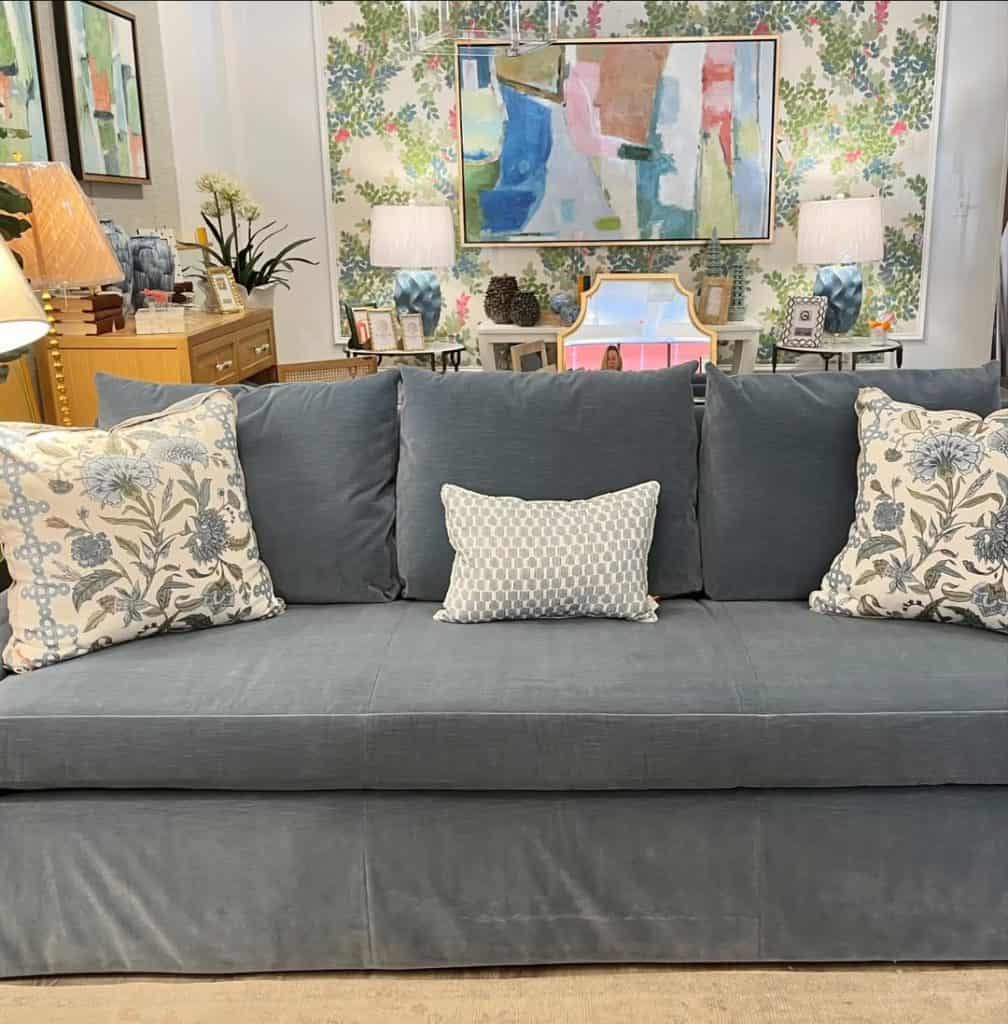
An abstract painting above a sofa with symmetrical lamps and deliberately mixed patterns is the approach for a living room that has a point of view.
What I find interesting about this idea is that the maximalism is structured, not chaotic. Two matching lamps flank the art. The cushions mix patterns, but in a controlled palette. Everything is abundant, but everything is placed. It’s the difference between maximalism as a style and maximalism as an accident.
If your instinct is to add more rather than edit away, this is the approach that vindicates you.
Moody Art + Neutral Sass
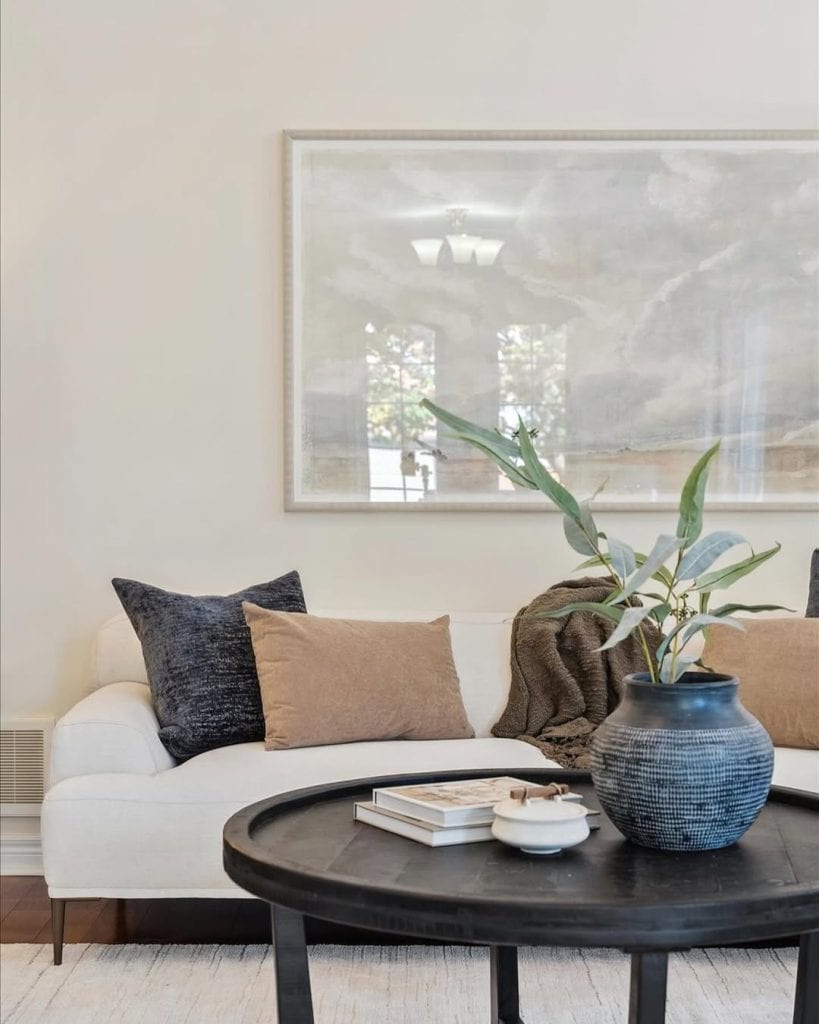
A single oversized painting in stormy, moody tones — dark water, grey sky, something with atmospheric weight — above a restrained, velvet-and-knit sofa setup is one of the most sophisticated combinations I’ve come across.
The art does all the emotional work. The sofa and accessories stay neutral, textured, quiet. Together they create a room that feels like it has weather — a sense of depth and atmosphere that brighter, airier palettes can’t quite achieve.
Marina decorated her apartment’s main wall this way. I walked in and wanted to sit down immediately. That’s the test.
Gallery Walls
A gallery wall is one of the most personal things you can put in a living room, and also one of the most forgiving — you can add to it, move things around, replace pieces as you find better ones.
Gallery Wall
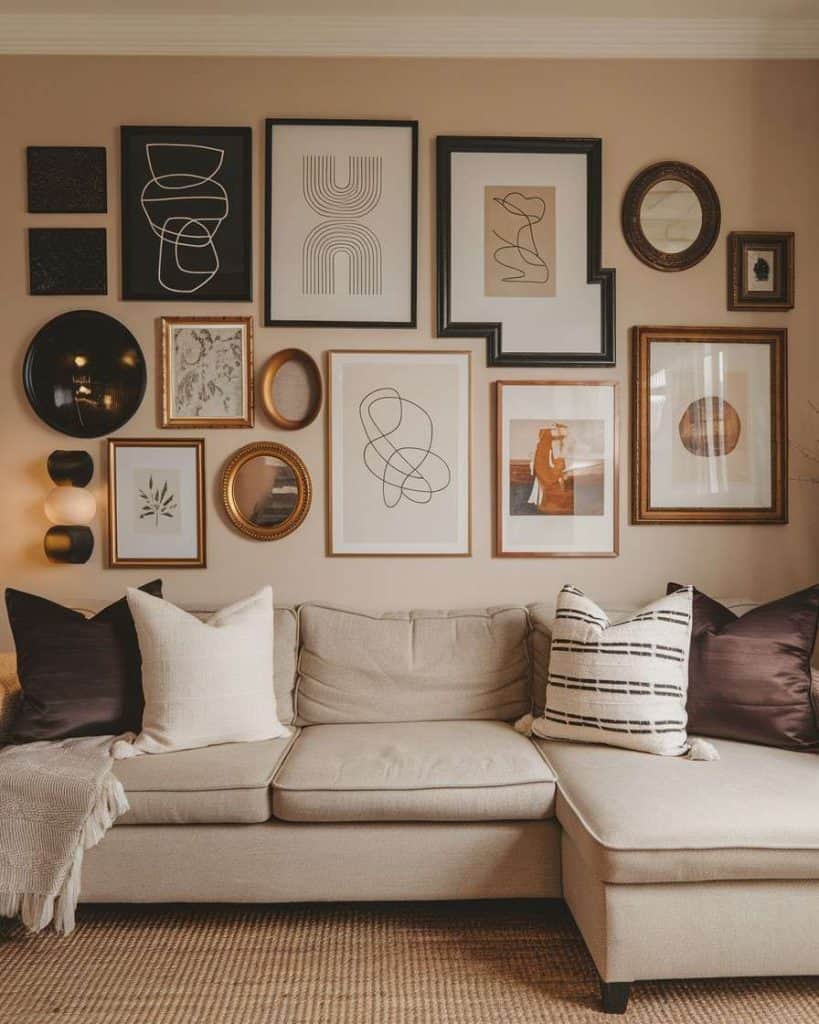
The classic approach: several pieces arranged together, treating the wall as a single composition rather than a collection of individual frames.
The key is consistency somewhere. Frames don’t all have to match — in fact a mix of styles is often more interesting — but they should share something: a color family, a metal tone, a level of formality. That shared element is what makes a gallery wall feel curated rather than accumulated.
Lay the whole arrangement on the floor first before committing to the wall. Move things around until the spacing feels even and the visual weight is balanced. Then take a photo on your phone and live with it for a day before making holes.
Hanging Gallery Rail Charm
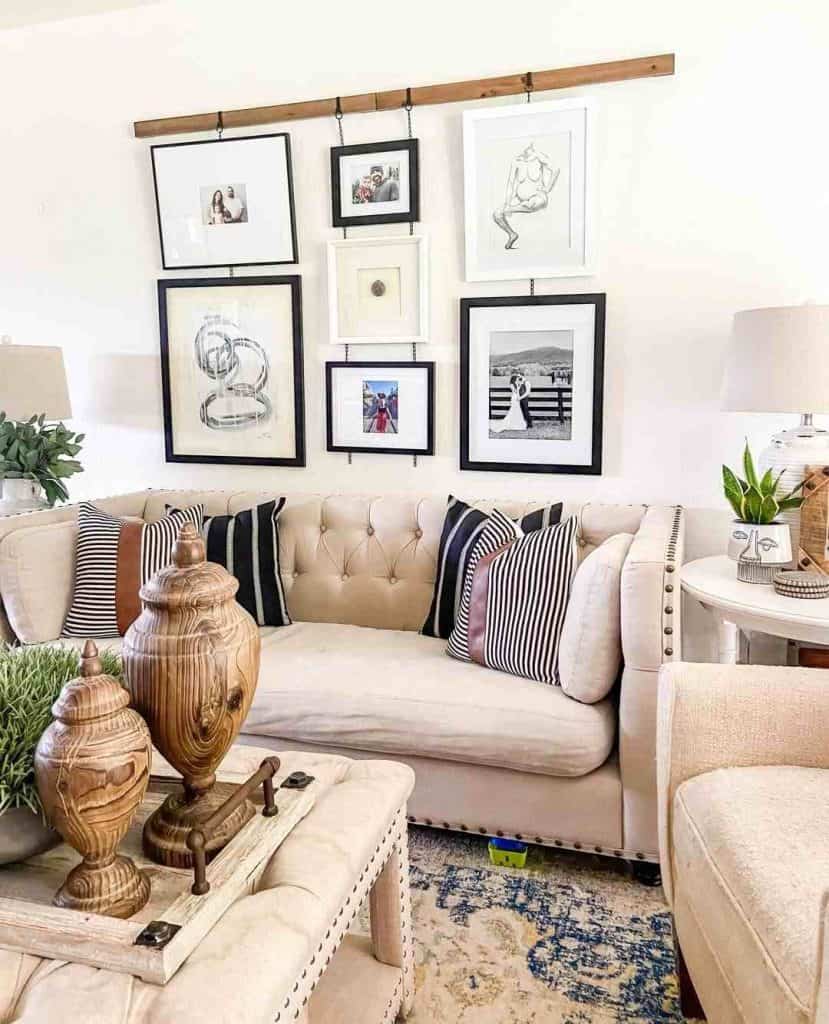
A wooden rail on chain links — a picture rail — from which art is hung without nail holes is one of the most practical gallery wall solutions for anyone who rents, redecorates often, or simply hates committing to a single arrangement.
The rails have a lovely character of their own. They reference the way galleries and Victorian parlors hung art — adjustable, addable, moveable. You can swap out a sketch for a photo, add a new find from a market, or rearrange the whole thing on a Sunday afternoon without touching the wall.
The look is a little artsy, a little collected. For a living room that wants to feel like it belongs to someone creative, it’s one of the most honest choices you can make.
Rustic Family Storyline
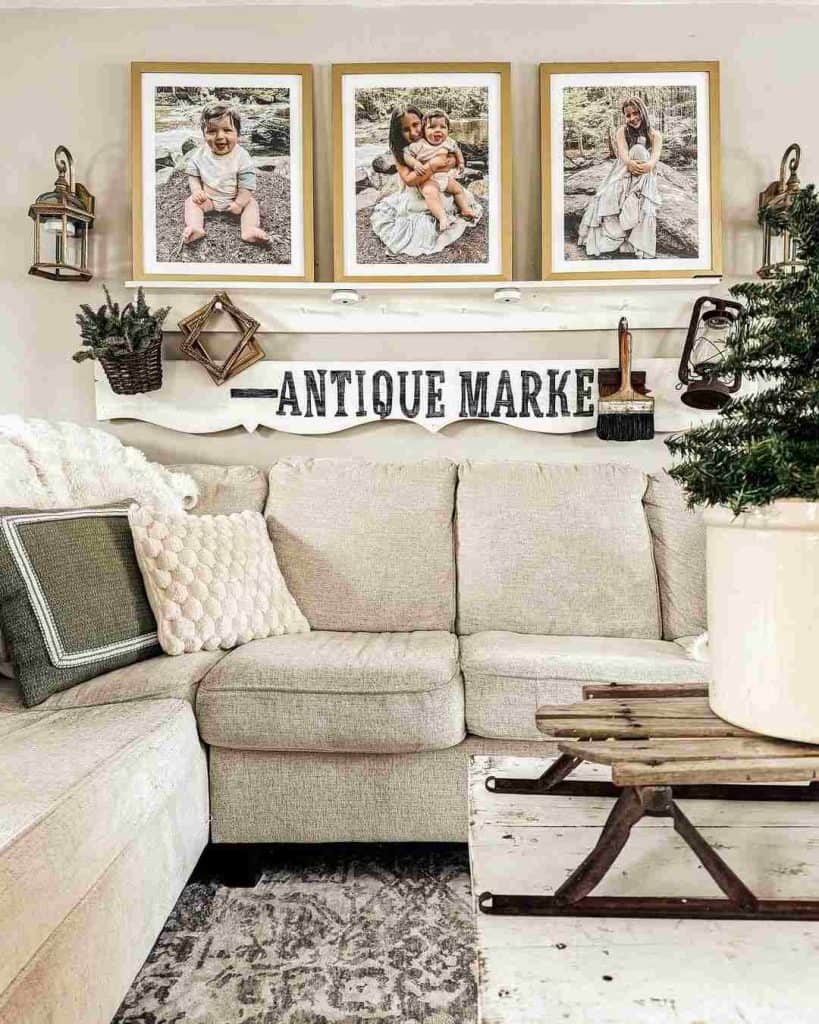
Golden-framed family portraits above a weathered sign — something with words, something that means something — is the approach that makes a living room feel like it belongs to a specific family rather than any family.
I don’t usually talk about displaying family photos in a designed context because it can go either way. But this combination — the warmth of gold frames, the weathered texture of a sign with meaning, the faces of people you love — is one of those rare instances where sentiment and style pull in the same direction.
The trick is the frames. Matching golden frames give family photos a level of formality and intention that cheap plastic frames don’t. The same photos in beautiful frames look like considered art. The same photos in mismatched frames look like you ran out of wall space.
Layered Landscapes
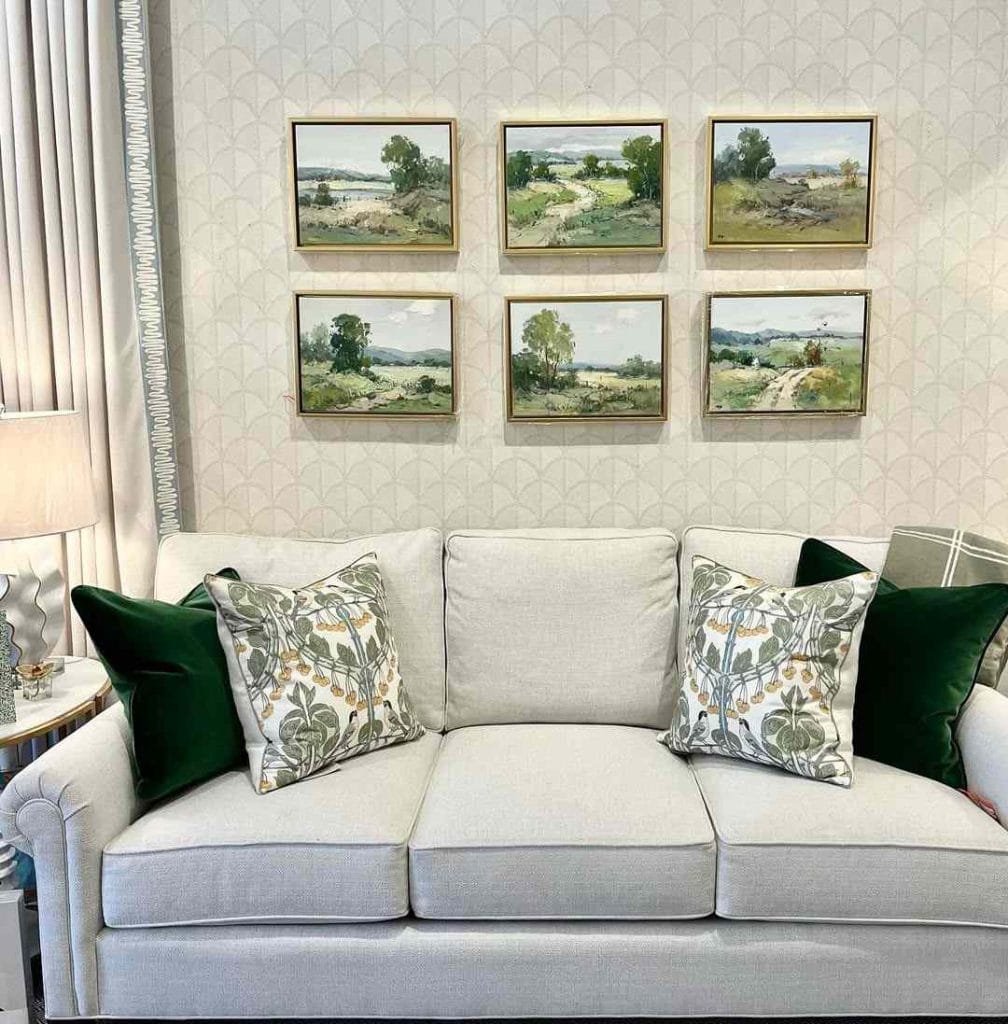
Six framed countryside scenes against patterned wallpaper in soft greens and blues is the most serene gallery arrangement I’ve come across.
The wallpaper is doing something important here: it softens the separation between the frames and the wall. Instead of rectangles floating on paint, the whole surface becomes a composition — wallpaper, frames, and art working together. The similar palette between the wallpaper and the paintings means everything reads as one quiet, layered statement.
If you’ve been hesitant about wallpaper because you can’t commit to a whole room, a single wall behind the sofa is the most manageable place to start.
Mirrors, Texture, and Organic Shapes
Not everything above a sofa needs to be framed art. Some of the best solutions are three-dimensional, tactile, or reflective.
Choosing an Oversized Mirror
A large mirror above a sofa is the one move that does three things at once: it makes the room feel bigger, it bounces light around, and it creates a focal point.
The key word is oversized. A small mirror above a large sofa looks like a mistake. You want a mirror that’s roughly proportional to the couch beneath it — something that really occupies the space. Leaning a large mirror against the wall (rather than hanging it) is also an option, and in the right room it looks intentional and relaxed rather than just unwilling to commit.
I had a period of rearranging the living room at least four times. Every time I moved the mirror, the room felt different. It’s the piece of furniture with the most leverage.
🔥 Would you like to save this?
Mixing in Macrame and Textile Art
A large, neutral macrame piece above a sofa adds texture and warmth in a way that no flat artwork can match.
Macrame is tactile. It casts small shadows as the light moves. It brings in a handmade quality that manufactured prints and frames don’t have. A large natural-fiber macrame — the kind that takes up serious wall space — reads as deliberate and considered even though it’s one of the more accessible above-couch choices available.
It works best on lighter, calmer walls. Against white or warm cream, the texture of the weaving is what you see first, and that’s the point.
Choosing Baskets and Woven Tapestries for Warmth
Hung baskets on a wall are one of those ideas that sounds like a trend but has been around long enough to be a tradition.
Woven baskets — round, shallow, in different sizes — arranged asymmetrically above a sofa add warmth, texture, and a handcrafted quality that frames can’t match. A woven tapestry works the same way in a different form: more graphic, more structured, but still textile, still handmade-feeling.
Zina has a wall of woven baskets in her hallway that she’s been building for twenty years, one at a time from markets and trips. It’s the most characterful wall in her house. Some design approaches just take time to become beautiful.
Earthy Boho Bliss
A macramé wall hanging with terracotta tones, paired with a rattan loveseat and trailing plants, is the most committed version of the organic-texture approach — and it pays off completely.
What makes this combination work is the through-line of handmade quality. Rattan furniture, macramé, trailing potted plants, terracotta tones — everything in the composition has been touched by a human hand at some point. Nothing is polished, glossy, or manufactured-feeling. The room has a quality of warmth and life that very precise, very decorated rooms often lack.
If your instinct is toward natural materials and warmth over sleekness, this is the direction that rewards you most.
Whimsy in Bloom
Hand-painted decorative plates and small wall planters above a deep blue couch add playful color and a quality of abundance that is very specifically cheerful.
Displayed plates are an old European domestic tradition and one that deserves more attention in modern living rooms. Ceramics on walls add color and dimension without the formality of framed art. Mix hand-painted floral plates with a small hanging planter or two and the wall above the sofa becomes something almost garden-like — full of color and growth without being overwhelming.
Maria has a collection of hand-painted plates she’s been finding at markets since she was a teenager. One day she’ll have enough for a proper wall arrangement. That day is going to be wonderful.
Shelves, Light, and Structure
Sometimes the answer above a sofa isn’t artwork at all — it’s function, light, or a composed arrangement of things you already love.
Floating Shelves
Shelves above a sofa let the display evolve over time — a plant added here, a new book there, a ceramic found at a market slipped onto the end.
The key is restraint in the shelf itself. Clean, simple shelves — floating brackets, minimal profile — disappear into the display. Chunky, complicated shelving hardware competes with whatever’s on it. The shelf’s job is to hold things and stay out of the way.
Vary the height of objects: a stack of books next to a vase next to a trailing plant next to a small framed print. The variation creates interest without requiring every object to be beautiful on its own.
Soft Shelves & Cozy Spells
Floating shelves holding ceramics, greenery, and books above a neutral sofa is the specific combination that feels the most liveable and the least like you’re trying.
Neutrals below, varied heights and textures above. The greenery introduces life. The ceramics introduce craft. The books introduce the sense that someone actually lives there. It’s an arrangement that manages to feel both styled and completely natural at the same time — the highest possible compliment for any shelf arrangement.
Wall Sconces and Lighting
Wall sconces on either side of a central piece — a painting, a mirror, a shelf arrangement — do something that almost nothing else does: they make a wall feel finished.
Functional light sources treated as decorative objects are a deeply underused tool in living rooms. A sconce on each side of the sofa wall adds warmth in the evening when overhead lighting is too much, and adds a architectural symmetry that makes even a simple arrangement look intentional.
They don’t have to be hardwired. Plug-in sconces with attractive cords are widely available and achieve the same effect with no electrical work. Tasos installed ours on a Saturday morning. The wall immediately looked like it had always been planned.
Creating a Symmetrical Display
Two matching objects mirrored on either side of a central anchor — a large clock, a painting, a mirror — is the approach for a living room that wants to feel calm and deliberately composed.
Symmetry is calming. It reads as considered. And above a sofa, where the geometry is already very horizontal and formal, symmetry feels right in a way it doesn’t always feel in other parts of the room.
The central anchor does most of the work; the flanking pieces support it. Keep the flanking elements truly matched — same size, same frame, same height — and the whole arrangement will look as though it was designed by someone who knew exactly what they were doing.
Farmhouse Cheer, but Make It Chic
A reclaimed window frame, a simple wreath, and checked cushions on the sofa below create a cozy cabin feeling that walks the line between country charm and genuine style.
The reclaimed window frame is the specific idea I keep coming back to. A large vintage window frame — the kind with divided panes — has exactly the right scale for above a sofa and a quality of age and history that nothing bought new can replicate. Hang it flat on the wall and it reads as art. Add a small wreath inside one of the panes and it becomes something more personal.
The checked pillows on the sofa beneath complete the visual story. The sofa and the wall are having the same conversation, and the room is richer for it.
One Last Thing
The wall above a couch doesn’t have to be solved all at once.
The rooms that feel most personal are the ones that built up slowly — a mirror that was already there, a painting found at a market two years later, shelves added when the arrangement needed anchoring. That accumulation is what makes a living room feel like it belongs to someone.
Start with one piece at the right scale. The rest will follow.

I’m Katerina Lithopoulou, co-creator of DIY Cozy Living. I’ve always loved the little things that make a space feel special. With a background in language and a passion for photography and cozy design, I enjoy turning everyday inspiration into simple ideas people can actually use.
My motto: “Cozy isn’t a trend — it’s a feeling.”
