

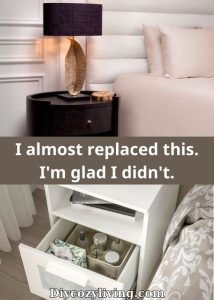
For a long time, I kept a list – a somewhat embarrassing, private list – of the things in our house which weren’t quite right, yet. The rug I would get round to changing when we were better off. The curtains I’d swap for something nicer. And, for years, near the very top of that list, a bedside cabinet.
Not because it was damaged, or because it was unattractive. But because it had cost €80, and I’d made up my mind – though never voiced it – that items costing €80 had no place in a home that one really meant to create.
I was mistaken. Not a little mistaken, but in a way that made me look at my home entirely differently once I understood it.
Here’s what altered my view – and the reason I believe MANY OF US are quietly committing the same costly error without realising.
“Cheap things look cheap. Expensive things look the way you want your home to feel.” — The rule I followed for years without ever questioning it.
The Principle I Didn’t Dispute
At some point during my decorating, I’d taken on a principle without ever deciding to do so. It went something like this: a home that looks correct is a home in which everything matches. And items that look correct cost money.
Therefore, cheap things look cheap – and expensive things look like the home you want to live in.
I never said this aloud. I never put it in writing. It was simply a feeling I had, the way you carry assumptions about things you value – quietly, and without questioning them.
The upshot of this was a constant list in my mind of things I’d like to replace one day. The bedside cabinet stayed near the top of the list for a good while.
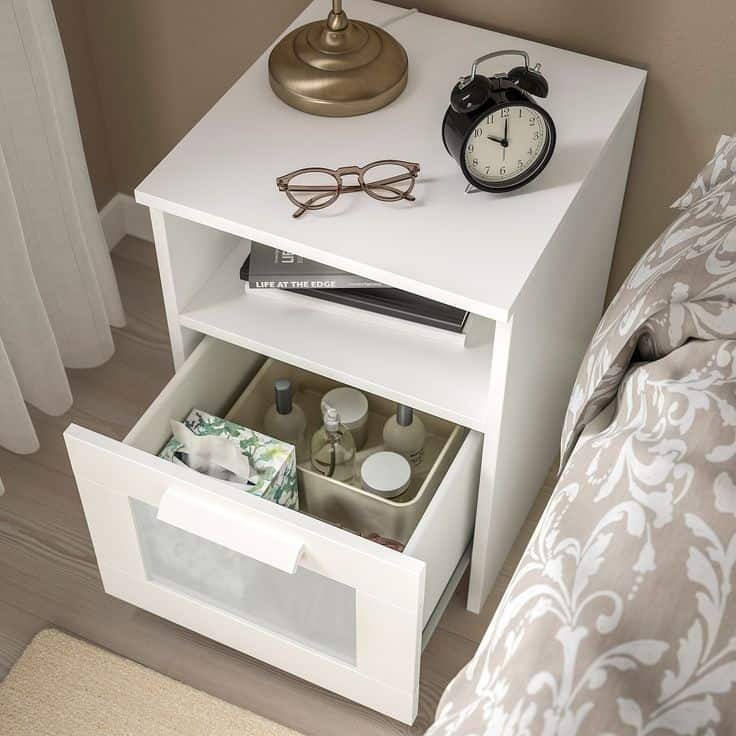
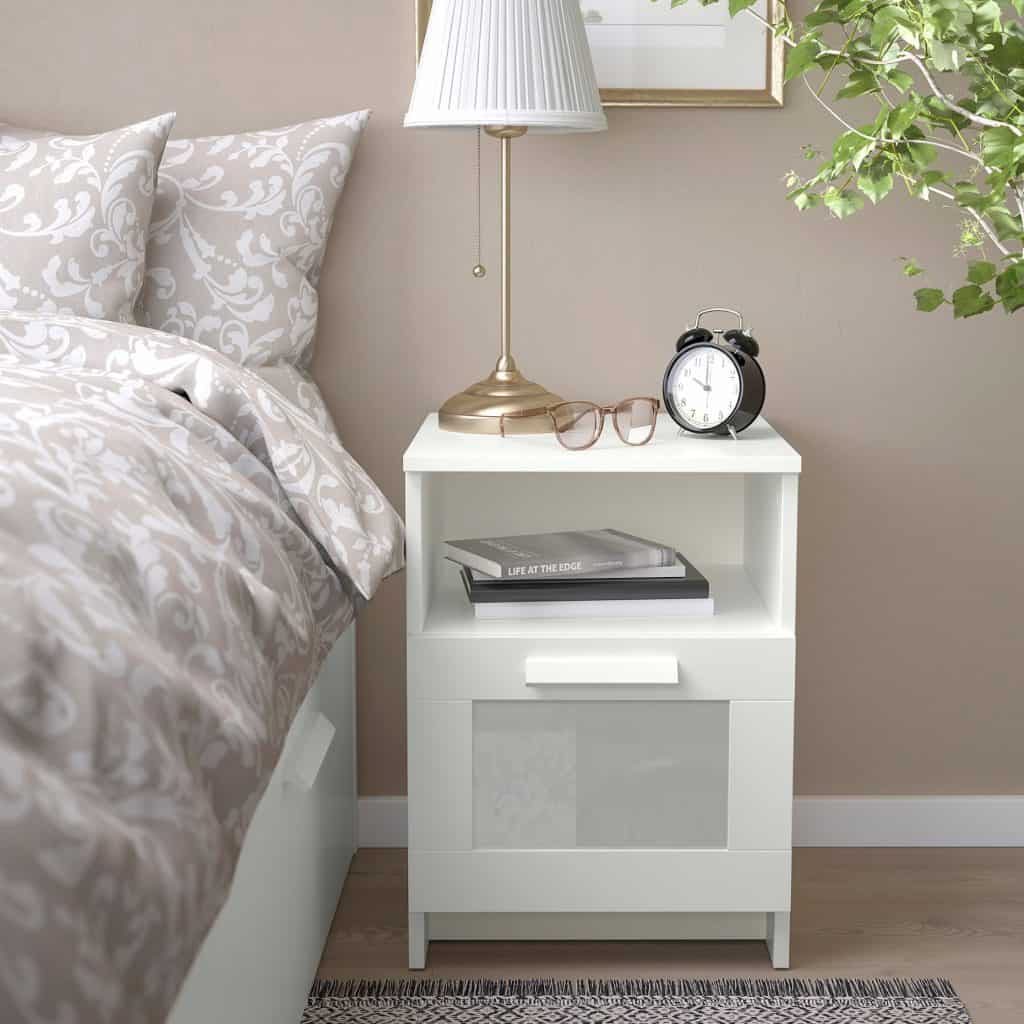
Our bedroom had evolved into something I was happy with. The bed frame was strong and solid, the sort of item which makes a room feel settled. The rest of the room had developed around it. Then there was the BRIMNES – white, simple, €80 – and every morning I’d look at it and think: eventually, I’ll change that.
The Table I Really Wanted

I’d come across it on the internet, as you come across things you can’t really afford, but can’t stop thinking about.
The Eichholtz Rosemberg Nightstand. Charcoal grey oak veneer, brushed brass fittings, an oval shape which somehow manages to be at once modern and classic.
It looks great in photographs. It appears to be precisely the sort of item that belongs in a bedroom which has been very carefully designed. In Europe, it costs €1,995. Almost two thousand euros. For a bedside cabinet.
I had saved it. I looked at it often, with the specific mix of desire and remorse which expensive things you don’t need tend to create. I said to myself: when we can, we’ll get something of that kind. Something which gives the impression that we are serious about this.
Meanwhile, the BRIMNES remained.
The Two Tables — Side by Side
| IKEA BRIMNES | Eichholtz Rosemberg | |
|---|---|---|
| Price | €80 | €1,995 |
| Material | Painted wood / MDF | Oak veneer, brushed brass |
| Style | Simple, clean, minimal | Contemporary statement piece |
| Best for | Any bedroom — blends quietly | Rooms built around it |
| Katerina’s verdict | ✅ Still in the bedroom | Beautiful. Not for my room. |
The Accident Which Changed Everything
I didn’t have a dramatic realisation. No design breakthrough, no article which altered my thinking. What occurred was far smaller than that – and so much more persuasive.
We redecorated the bedroom.
A warmer colour than we’d had previously, softer, the sort of shade which makes a room feel as though it’s embracing you at the end of the day. And when the paint had dried, and the room had settled into its new form, I looked at the BRIMNES and noticed something I hadn’t anticipated.
It looked perfectly at home.
Not like a temporary measure. Not like a compromise I was putting up with until the real thing turned up. It looked as though it belonged – the white against the warm wall, the uncomplicated shape next to the more substantial bed frame, the clean lines which didn’t clash with anything else in the room. It had been doing this all the time, quietly and without any help from me. I just hadn’t been looking at it properly, because I was too occupied with planning to replace it.
I stood in the doorway for a moment, looking at the room. And I thought: what, precisely, would I be spending €1,995 to improve here?
What I Actually Understood That Morning
The Eichholtz Rosemberg is a really lovely thing, I’ll be clear about that. The brushed brass, its oval shape, the good quality of what it’s made from – if you can afford it and it would be right for your room, I completely get why you’d go for it. This isn’t against lovely, costly items.
It is against believing the costly version of something is automatically the correct version for your home.
What gives a room the right feeling isn’t how much anything cost; it’s size – whether an item suits the area around it. It’s color and surface – if they seem to talk to one another. It’s how a room is in reality – how the morning sun falls on it, what it looks like in everyday use, not arranged to be photographed.
The BRIMNES suited my room. It suited the wall colour, the bed, the lamp, the way the area is really used each morning when someone sets down a glass of water, a book, and a phone charger, then goes to sleep. The Rosemberg, although beautiful, would have been a different feeling – bolder, more formal, something made to be seen instead of simply to do a job.
Not every room needs to be seen. At times the best thing in a room is the thing you stop seeing because it fits so well.
✦ Key Takeaway
The right piece for your room isn’t the most expensive option — it’s the one that fits your space, your light, and how you actually live in it. Don’t replace what already works.
The rule I follow now
I still save lovely, costly items on the internet sometimes. I still notice when something is well-made and looks amazing. That hasn’t altered.
What has altered is the question I ask before I decide something is too costly or not costly enough. It isn’t: how much does this cost? It’s: does this actually suit the room I actually have?
A €2,000 bedside table which clashes with your wall colour, is too big for your area, and makes you feel you must keep the rest of the room at a certain level just to justify it – that is a more costly mistake than an €80 one which does its job quietly and well for years.
The BRIMNES is still in our bedroom. I stopped thinking about changing it some time ago. The place it’s from – simple, functional, a little bit unassuming – turned out to be exactly what the room needed all along.
The most surprising thing about letting go of the rule was how much lighter everything felt afterwards. I stopped looking at our home as a collection of things to improve and began to see it as a place which was already, mostly, exactly right.
A note on mixing costly and cheap
This is the part I wish someone had told me at the start: rooms that look truly interesting almost never come from one price level. The areas I find most lovely – in person, not in pictures – tend to mix things freely.
A well-made bed frame next to an IKEA bedside table. An old lamp on a new shelf. Something cheap which has exactly the correct shape next to something costly which has exactly the correct weight.
This sort of mixing isn’t a compromise. It is actually harder to do well than buying everything from the same place at the same price, because it needs you to look at each thing honestly and ask if it suits – not if it belongs to the correct cost group.
The €80 table next to the more costly bed isn’t a bad match. It’s a decision. And now that I’ve accepted it, it feels like one of the better ones I’ve made in this bedroom.
Until next time,
Stay safe,

Katerina Lithopoulou is the founder of DIY Cozy Living. She has been decorating homes on a budget for over ten years – and sometimes learning her best lessons from the things she almost changed.

I’m Katerina Lithopoulou, co-creator of DIY Cozy Living. I’ve always loved the little things that make a space feel special. With a background in language and a passion for photography and cozy design, I enjoy turning everyday inspiration into simple ideas people can actually use.
My motto: “Cozy isn’t a trend — it’s a feeling.”
