
How to Choose a Good Watermelon (My Father Finally Figured It Out)


There is not much my father Sakis has done for the better part of fifty years that he hasn’t done with watermelons.
For most of that time, he was like anyone else in his approach.
You look at them, pick up a specimen that is big enough and of the proper colour, and give it a tap on the side with your knuckle. He would do as men of his generation are wont to do, as though the fruit might offer some kind of answer if you knocked hard enough.
Therefore, it was hit-or-miss.
My mother Zina put up with it, being patient as she is with a great many things. But a few summers back Sakis had a change of heart.
He began to put in the work at the market, asking around and doing some reading. He would try out different methods on a number of melons in a season to see what stuck, building a system he could rely on instead of his old habits.
Take last August. He put in six watermelons over the summer and they were all first rate. Zina made note of it, which in our house is as good as a standing ovation. What follows is the sum of what he has learned, along with some of the research he didn’t see fit to talk about.
The Things That Actually Tell You Something
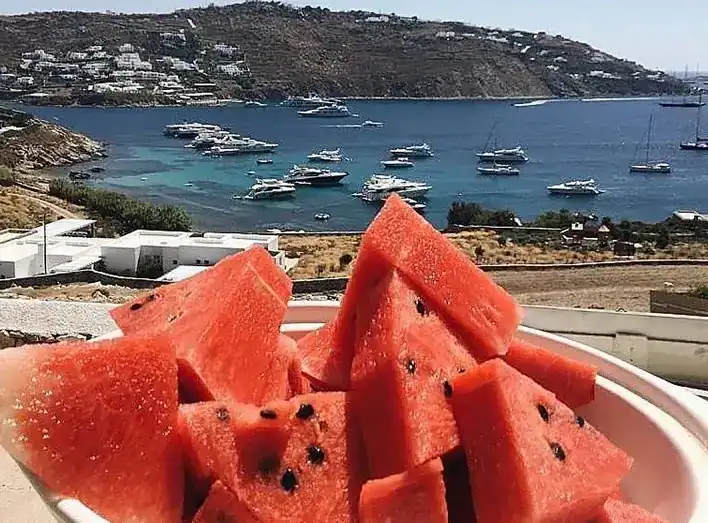
There are a lot of watermelon selection methods floating around and not all of them are equally useful. Some are reliable indicators. Some are folklore that happens to be right sometimes. Some are completely useless.
Here’s the honest breakdown.
The Field Spot
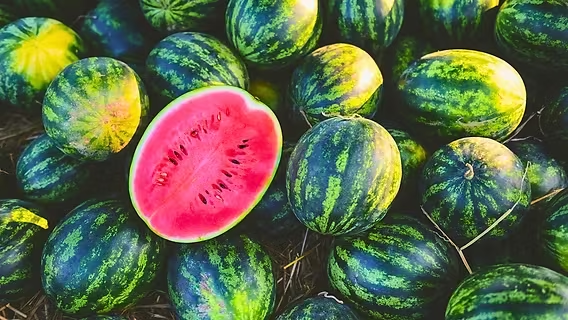
Flip the watermelon and have a good look at the underside, the part that was on the ground as it grew. You will see what is known as the field spot; in terms of telling you if a melon is ripe, there is nothing more dependable.
If it’s well and truly ripe, that spot will be a creamy yellow or even a deep orange-yellow. The more pronounced the colour, the more time the fruit has had to bask in the sun and ripen on the vine. A white or pale yellow spot is a giveaway that it was harvested too soon.
Sakis makes it his first point of call these days. “It never lies,” he’ll tell you.
The Sound Of The Watermelon Actually Matters!
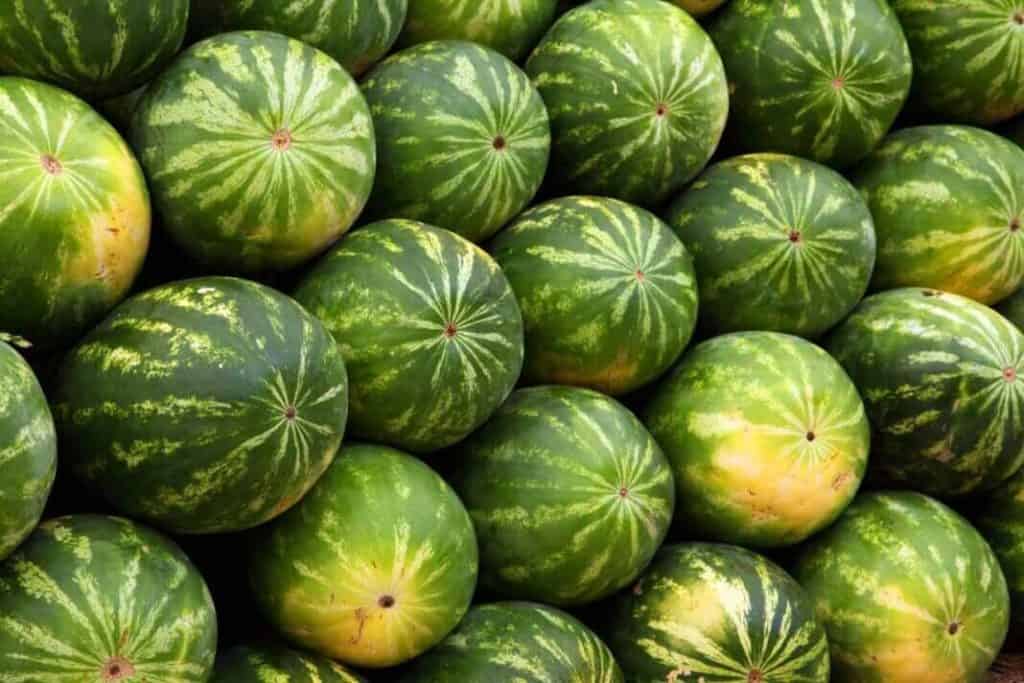
There is no more well known way to pick a watermelon than by giving it a knock and listening, and while the technique has its merits, most folks don’t really grasp the why of it all and so they miss the mark in what they hear.
Tap a ripe specimen and you will get a deep, hollow thud, not unlike rapping on a door. Do the same with an unripe one and it gives off a higher, tinny sort of ping, very metallic. An overripe melon is the opposite; the sound is flat and dull as if you were hitting something dense.
It comes down to the fact that with ripening the flesh is packed with water and sugar, altering the way sound moves through it. The even distribution of that density in a good watermelon is what produces the hollow resonance.
Then you have someone like Sakis who has been at it for decades and has put in the time to learn exactly what he should be hearing. For those of you whose ear isn’t yet trained to it, I would suggest using this in conjunction with the field spot instead of putting your faith in it alone.
The Tail
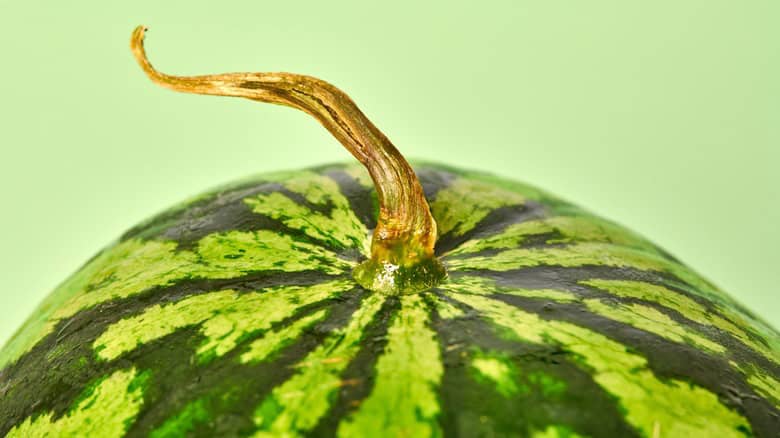
Sakis will have you check the watermelon for a stem or a bit of dried tendril if it is there. It is a quick and easy first filter in his book before he gets to anything else.
The colour of the tail is what matters.
If it is green and looks fresh, the melon was cut from the vine prematurely, so he puts it back. But a tail that is dry, brown and curled is a sign it was allowed to ripen on the vine as it should. Should you find one with no tail, don’t read into it.
You won’t get any useful information from that, only that it has been removed at some point.
The Shape
You can tell a good watermelon by its symmetry and even shape, a sign it has had all the water and nutrients it needs as it ripens.
If you see one that is lumpy or irregular, the growing conditions were likely not up to par; inconsistent watering will show in an uneven sweetness within the fruit.
As a rule of thumb, the rounder varieties are sweeter and have more of a watery quality, while the elongated type is a bit denser and not quite as sweet. There is no right or wrong choice, it depends on your purpose.
Sakis, for instance, will go for the round ones to eat on their own. But if he is putting together a fruit salad and wants to avoid too much juice, he finds the elongated ones work better.
The Skin
Don’t be put off by a watermelon with a dull, matte finish; in fact you want to avoid the ones that are too glossy, for that is a sign of an underripe fruit.
🔥 Would you like to save this?
It may seem to run counter to what we expect, given our habit of equating a sheen with something fresh, but on a watermelon a lack of luster means it has ripened as it should.
Then there are the stripes. You will want to see a good deal of contrast between the dark and light green, with the lines well defined. If they look faded or indistinct, it is likely the watermelon never fully developed.
The Weight
Pick it up. A good watermelon should feel heavy for its size. This is because a ripe watermelon is around 92 percent water, and all that water has weight.
A watermelon that feels lighter than it looks hasn’t fully developed its water and sugar content yet.
If you have two watermelons of similar size, choose the heavier one. Every time.
The Size
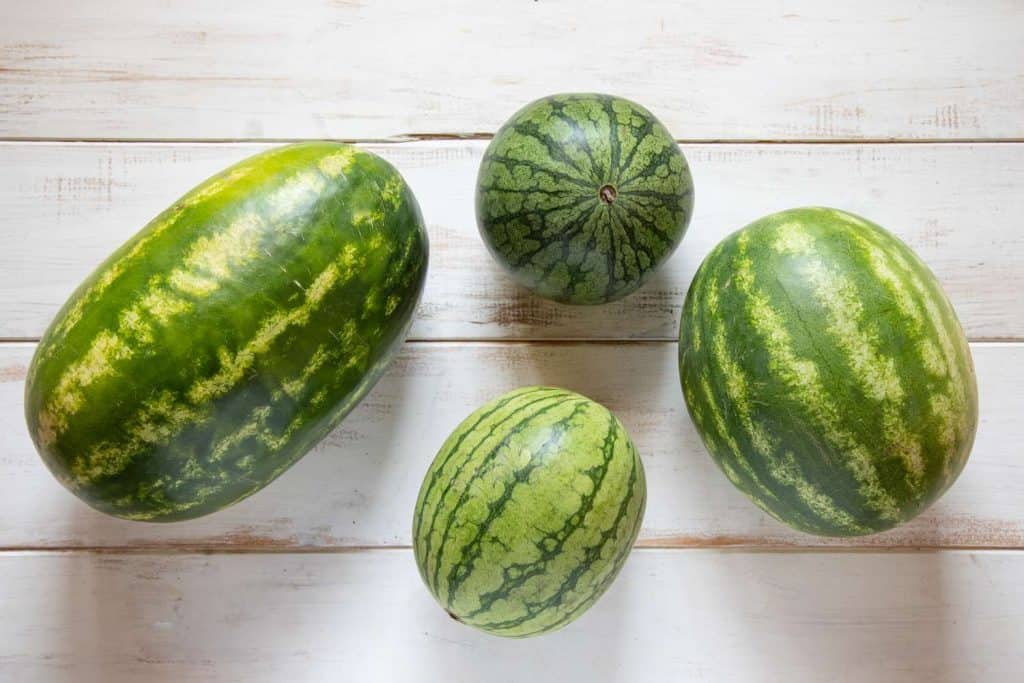
Medium sized watermelons are more consistently sweet than very large ones.
This surprises people because bigger seems like more, but very large watermelons have often grown fast rather than slowly, which means less concentrated sweetness.
The ones that ripen slowly and reach a moderate size have had more time to develop sugar.
A quick reference guide for what to look for:
| What to check | What you want | What to avoid |
|---|---|---|
| Field spot | Creamy to deep yellow | White or pale yellow |
| Sound | Deep hollow thud | Tinny ping or dull flat sound |
| Tail | Dry, brown, curled | Green or fresh looking |
| Shape | Symmetrical, even | Lumpy or irregular |
| Skin | Dull, matte | Shiny |
| Weight | Heavy for its size | Lighter than it looks |
| Size | Medium | Very large |
A Few Things That Don’t Tell You Much
The colour of the stripes. Beyond the basic contrast point mentioned above, the specific shade of green doesn’t tell you much about what’s inside. Some varieties are naturally lighter or darker and colour alone isn’t a reliable indicator of sweetness.
Scratching the skin. Some people scratch the outer skin with a fingernail and judge ripeness by how easily it marks. This is more folklore than science. It tells you more about the thickness of the skin than the ripeness of the flesh.
The smell. A cut watermelon smells distinctly sweet when ripe and this is a reliable indicator. An uncut watermelon at the stem end may have a faint sweet smell when very ripe. But the smell of an uncut watermelon is subtle enough that it’s hard to use reliably in a busy market with many other smells competing.
At the Market Versus the Supermarket
When you’re at an open-air market, you have your work cut out for you: heft the watermelon, give it a good tap, see how it looks from every side. You can do all of that.
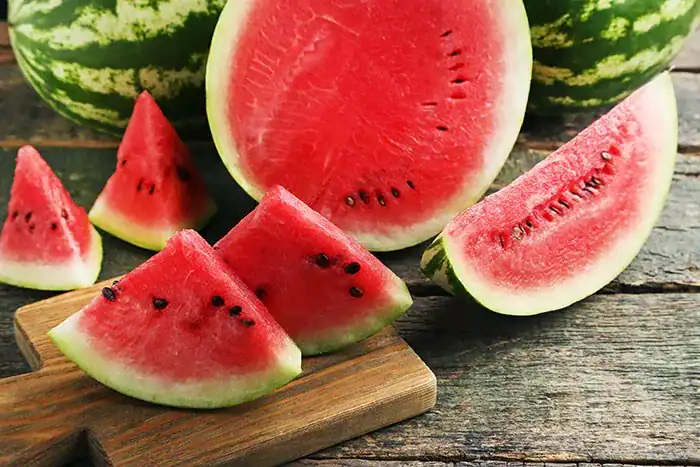
In a supermarket, not so much. If you’re faced with one of those pre-sliced and cellophane-wrapped melons, you can’t be as hands-on. In that case, just look at the meat of it.
You want to see a rich red, and if you’re lucky, some of those little white or clear specks on the surface where the light hits them are sugar crystals.
The seeds should be dark.
If they’re white, the melon is under-ripe. (The crystals tell you it’s the other way around.)
And if the colour is more of a pale pink, leave it be.
A Final Thought
Back in August, Sakis put a watermelon in front of Zina on the counter and made his case. You could tell from the way he said it that he’d done his homework and was sure of himself: this one would be a keeper.
And he was right. Zina vouched for it. He didn’t say much about it at the time, but I saw him bring it up again a few days on in some other talk. That’s his way of making a point without being obvious about it.
He’s been around for fifty or so watermelon seasons. He has a feel for them now.
I’ll leave it there for now. Do you have a system for picking a good one that I’ve left out? Put it in the comments!
Can’t wait to hear your thoughts and your tricks!
Until next time,
Stay safe,


I’m Katerina Lithopoulou, co-creator of DIY Cozy Living. I’ve always loved the little things that make a space feel special. With a background in language and a passion for photography and cozy design, I enjoy turning everyday inspiration into simple ideas people can actually use.
My motto: “Cozy isn’t a trend — it’s a feeling.”
