
20 Low Ceiling Small Attic Room Ideas That Make the Most of Every Inch

🔥 Would you like to save this?
For years, the attic in our Volos summer house was just a place to put things. Not the tidy kind of storage, but the sort where you let it pile up: boxes from one year to the next, odds and ends with no home on the main floor but were too good for the bin. It was the kind of detritus you find in a house that has seen a few decades of family life. You’d pop the hatch, have a look at the low ceiling and the way the walls come in, and be done with it.
Until Maria and Marina made it their own.
I can’t quite put my finger on how it came about. But there was a summer when they went up and I didn’t see them for an hour. I went to have a word and found Marina using two cardboard cartons for a table, sketching on some paper she must have come by. Maria was on an old cushion with a book. No one had told them to; they just made up their minds that the space under the roof was to be had.
So we put in some work over the autumn. We put in a table small enough for the eaves, some floor cushions, a lamp, and a wooden box for the girls’ art stuff. From then on, the attic was their domain and hands down one of the best parts of the house.
It was a lesson in what a room with a low ceiling can be. The limitations — the slope, the lack of headroom, the odd shape — don’t need to be fixed. They give the place its personality. When you do it right, an attic has an intimacy a normal room with a flat ceiling will never have.
Here are 20 ways to get the most out of that kind of space.
Understanding What You’re Working With
You have to put a low-ceilinged attic in its own category. Don’t measure it up against an ordinary room and come away disappointed.
Then there’s the matter of the headroom. It’s not uniform; you’ll have your high point at the ridge and the eaves will be much lower. But that’s not something to fix, it’s a way to zone the room. You put the standing and walking where it’s tall. The nooks under the eaves are for sitting down, a bed, some storage, or a desk. A good design works with the slope, not against it.
And one more thing: if you do it right, a low ceiling can be a virtue. With the proper mix of colour, light and furniture, you don’t get a boxy feel — you get a room with some character, the kind of place you like to be in.
The Ideas
1. A Creative Corner for Children
You have the girls’ corner to thank for that. Their little drawing nook is case in point. We put a low table there, one of those 40-50cm from the ground, and it’s just right for the space under the eaves; an adult would be in the way, but not this. Some floor cushions in lieu of chairs, a wooden box or a small shelf for their things, and you’ve got it.
Kids are made for rooms with low ceilings. The height doesn’t register with them, and the whole thing has the feel of a den. It’s as good a spot as you can get for some drawing or reading or making up stories.
What works:
- Low tables under the lowest ceiling sections
- Floor cushions rather than chairs
- Open storage at child height
- Warm lighting that makes the space feel intentional rather than makeshift
2. A Reading Nook Built Into the Eaves
You’ll find that the space on either side of an attic, where the roof comes down to the floor, is for the most part put to no use. Put in some built-in seating with a cushioned top and drawers for storage and you’ve made the home’s finest place to read out of what was otherwise dead room.
Don’t let the low ceiling over a nook put you off; it’s kind of the whole idea. When you’re up there with a book, you don’t need headroom. What you want is to be put at ease, have some light, and be in one of those little enclaves that makes you feel like you’ve left the rest of the house behind.
If the building will allow for it, put in a window in the eave. There’s nothing like having natural light right at your level in a spot like that.
3. A Sleeping Loft or Bedroom
You don’t need much headroom to sleep, of course. But in an attic room you have to be able to sit up in bed, put on your clothes and make your way to the door. Even with a modest ridge height, there’s usually no problem making that work.
The trick is where you put the bed: have the headboard at the lower end and let the foot of it point toward the taller part of the room. That way, when you sit up you’re in the open space, not the eaves.
Then there are built-in beds. A simple platform with the mattress set in a bit will do the job with even less vertical room and has a more put-together feel than one that looks like you were forced to make do.
4. A Home Office Under the Roof
You can make a home office in a low-ceilinged attic, but there’s a catch: the desk has to be where the room is at its tallest so you can put in a regular chair and not have your head up against the ceiling.
I put the desk with the ridge in front of it and let a skylight do its job; come daytime, it’s the one spot in the house with any good light on it.
As for the rest of it, the shelves, the printer, what have you, that all tucks into the lower parts of the room. The walls on both sides, where the roof comes down, are lined with shelving from the floor right up to the slope. We don’t leave an inch to waste.
5. Built-In Storage Along the Eaves
You’ll find in any low-ceilinged attic that there’s a good deal of dead room up by the eaves, not enough to put in a piece of furniture. That’s where you put in some built-ins: drawers, cupboards, or open shelves to make use of it.
Let the height of the ceiling dictate the storage. You might have a shallow drawer close to the floor where the roof comes in, and as you go out and there’s a little more headroom, you can fit something with more depth. Then, where you can actually stand up, some open shelving for the items you like to have on hand.
It’s hard to beat this for making the most of a small attic. I’ve seen a bedroom eave with a custom setup put away as much as a whole wardrobe would, in an area that was otherwise just empty.
6. A Yoga or Meditation Space
You don’t need a lot of headroom for yoga or meditation. In fact, a low ceiling can be a good thing; it gives the room a kind of hushed, contained quality that’s conducive to some quiet time.
All you really have to do is put the floor to use. A nice mat, and not much else. Maybe a low shelf with a plant and a candle on it. Put in some blackout blinds if the early light is an issue.
There’s no better way to make use of an attic than to turn it into a place for stillness. Up a set of stairs or a ladder, away from the goings-on in the rest of the house, it’s a space you can truly call your own.
7. A Playroom
It’s like the little nook in the living room, only on a bigger scale. I’m thinking of turning the entire attic into a place for the kids to be. You put in some low-lying furniture, a few things to do on the floor, tuck some storage up in the eaves and have them pick out what goes on the ceiling.
When you give a child a proper playroom up in the attic, they don’t look at it the way they would a corner of the common area. It’s their domain. They make their way up there, and with them, the mess. We can be left to our own devices on the ground floor.
Then there’s Marina. She’ll have me repainting the whole ceiling come summer if I’ll let her. Up to now I haven’t. But I’m starting to think I should.
8. Light Colours on Every Surface
This isn’t so much a way to put the space to use as it is the underpinning for any good plan. If you have a low ceiling in an attic, nothing will open it up like white or near-white on the walls, floor and ceiling. Take the ceiling for instance: a dark one will come at you, but a white one seems to recede. Make it the lightest thing in the room.
Then let the floor pick up where the walls leave off with some pale paint or a light natural wood. You end up with a place that feels open and uncluttered, no matter what the square footage says.
9. Skylights
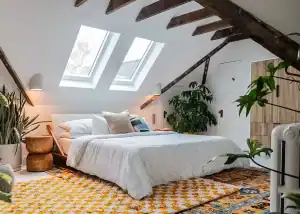
You can’t put a price on the way natural light from overhead will transform a room with a low ceiling like an attic. Put in a regular window and you’re only getting light from one side. A skylight, on the other hand, comes in from right above and lets it fill the room.
With just one in the right spot, you’ll notice a world of difference in how the space feels: it’s more open, has some height to it, and is simply brighter. Go with a pair on opposite sides of the roof and the shadows are gone.
When you have to pick one thing to do with your budget for an attic, make it this.
10. Low-Profile Furniture Throughout
Standard furniture in a low ceiling room fights the space. A sofa with high arms and a high back sits wrong under a sloped ceiling. A bed frame with a tall headboard bumps into the slope.
Low-profile furniture — floor sofas, platform beds, low coffee tables, shallow shelving — works with the ceiling rather than against it. The furniture scale matches the room scale and everything looks proportionate rather than crammed.
| Furniture | Standard Height | Low Profile Alternative |
|---|---|---|
| Bed frame | 60-70cm | Platform bed 25-35cm |
| Sofa | 85-90cm | Floor sofa 60-65cm |
| Coffee table | 45-50cm | Low table 30-35cm |
| Bookshelf | 180cm+ | Low shelving 90-120cm |
11. A Craft or Hobby Room
You want a room of your own for the hobby, be it sewing, models, or painting — something with a fixed place where you don’t have to put everything in a box when you’re done. The attic is the spot for that. It’s off on its own and you can let the clutter be.
The low headroom is no problem. When you’re at a table working on a project, you aren’t standing up. What’s over your head doesn’t matter.
Put a worktable in along the long wall where there’s most room. Tuck some storage in the eaves for your gear, add a decent lamp, and you’ve got yourself a craft room.
12. Exposed Beams Left Visible
You’ll find the beams in most attics. It’s a matter of either leaving them as is or, if they’ve been put to cover, showing them off. They put some life and warmth into the room that you won’t get from a flat, plastered ceiling.
Go with white for a clean, Scandinavian look; let the wood be what it is and you have something more of a tradition. Or try a dark hue on a white ceiling and they stand out as a design statement.
Then there’s the practical side: they’re a handy place to put up a light, some shelves, even a swing. You get the utility on top of the good looks.
13. A Guest Bedroom
You can’t go wrong with an attic for a guest room; in fact, it’s hard to put into words how much the people who stay in it will like it. With its low ceiling and slanted walls, you get a feeling of being put out of the way in a good sort of way. It’s a retreat, not just another room.
The trick is to let the space be what it is. Put down a solid mattress on a low bed, make it up in white, and have a single lamp. The eaves are there for built-in storage of linens and the like. Maybe a mirror or two on the wall.
Ask anyone who has been in the Volos attic and they’ll talk about it. That’s the one they don’t forget.
14. Use the Ridge Height for Hanging Storage
You would be hard pressed to put the ridge of an attic to good use. Being the furthest point from the floor, it is an awkward place to get to and so is left underused. Yet there is a logic to having storage up there for items you don’t have cause to reach for often; they are overhead and out of the way.
Put in some hanging rails for clothes of another season, or hooks for your hats, bags and the like. If the space is next to a kitchen garden, a rack to dry herbs on is a nice touch. In the end, what seems like wasted room at the ridge turns out to be the most convenient overhead storage in the house.
15. A Dark Cosy Den
You would not expect it when you read most of the advice on attics, which is to keep things light. Yet there is a case for making the room deliberately dark: put in some deep green or navy walls, dark wood pieces and an Edison bulb for warm illumination. In doing so you are not at odds with the low ceiling but working with it.
What you end up with is a den, or a cave. A place to be alone with your thoughts, or to read, or put something on the telly. The low ceiling is what makes it. It doesn’t feel cramped so much as enclosed; the darkness has the effect of making the few warm lights seem like the only ones that exist.
Tasos has made no secret of his preference for this sort of thing, he has been known to say so. I can’t make up my mind one way or the other.
16. Angled Ceiling as a Feature Wall
Instead of treating the sloped ceiling as a limitation, treat it as the most interesting surface in the room.
Paint it a different colour from the walls. Wallpaper it — sloped ceilings take wallpaper beautifully and the pattern follows the angle in a way that looks completely intentional. Line it with thin timber boards for a cabin aesthetic. Install strip lighting along the angle so the slope is illuminated rather than shadowed.
The angled ceiling is the room’s most distinctive feature. Treating it as a feature rather than a problem changes everything about how the room reads.
17. A Music or Recording Room
Low ceilings are acoustically interesting. The reduced volume of air, the irregular shape, the angles — these affect how sound behaves in ways that can be very good for certain types of music.
For a practice room — guitar, piano on a low keyboard stand, vocals — the attic works well. The sound stays contained and the separation from the rest of the house means playing doesn’t disturb anyone.
For recording, the irregular shape and low ceiling actually reduce echo in a useful way. Add some acoustic panels to the sloped walls and the natural acoustic properties of the space become an asset rather than something to compensate for.
18. A Dressing Room
A dressing room needs a mirror, storage and enough space to move. It doesn’t need ceiling height except at the point where you’re standing dressing — and that’s only at the highest point of the attic.
Built-in wardrobes along both eave walls. Open hanging at the highest section. A full-length mirror at the ridge where the ceiling is highest. A small upholstered bench under the slope for sitting while putting on shoes.
This is one of the most practical uses of an attic because it takes a function — getting dressed — completely out of the bedroom, freeing that room for sleep and nothing else.
19. A Photography or Art Studio
Natural light from a north-facing skylight is the most consistent, shadow-free light available for photography and painting. Attic rooms on the north slope of a roof get this light without any direct sun — even, diffused, exactly what artists and photographers need.
A north-facing attic skylight is rare and valuable. If your attic has one, or could have one, a studio is the best possible use of the space.
Clear floor for a shooting area. White walls for neutral background. One long work table at the highest point. Storage built into the eaves.
What Makes All of These Work
You will find three common denominators in any low ceiling attic room that has been done well.
For one, the occupant has given some thought to the height of the ceiling and put activities where they belong. You stand at the ridge, sit in the middle and reserve the eaves for lying down or putting away things in low-level storage.
Then there is the matter of scale. The furniture should be in proportion to the space, with a low profile so as not to have anything at odds with the ceiling.
And you cannot do without light. A skylight for the natural kind is best. For artificial, go with warm tones from fixtures at mid or low level instead of a lone overhead fitting. There is no point in getting everything else right if the lighting is poor; an under-lit room will feel oppressive no matter what. Do it right and it is inviting.
Make no mistake, if you have these three elements in place, the low ceiling ceases to be a hindrance. In fact, it is what gives the room its character and sets it apart from the rest of the house.
A Final Thought
You can still find the girls’ drawing corner up in the attic at Volos. There’s the low table set under the eaves, a few cushions on the floor and the old wooden box with their things. And if you look up, you’ll see Marina’s work tacked to the slanted ceiling right over the table. She put them there so she could have them looking down on her as she put pencil to paper.
I’ve been tempted to put some order to it, make it a bit more of an adult space. But I never go through with it. As soon as I’m up there and see what she’s done with the ceiling, I let it be.
There are some places that tell you what they’re for before you can even get around to making a plan. You just have to accept it and leave well enough alone.
That’s it from me for now. Do you have an attic you’ve put to some good use? I’d be interested to read your take on it below. They’re the kind of room in a house where you’re repaid for any imagination you put in, and the most interesting ones are the ones with a point of view.

I’m Anastasios Moulios, co-founder of DIY Cozy Living. I enjoy finding creative, practical ways to make small spaces feel warm, stylish, and lived-in. I started this blog with Katerina to share real ideas that make a home feel a little more personal and a lot more comfortable.
