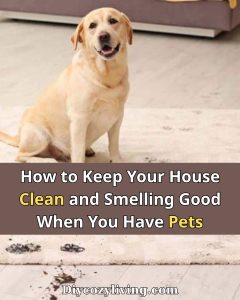
How to Keep Your House Clean and Smelling Good When You Have Pets

Chrysa, my sister-in-law, has two cats. I mean that with all good will since I have a fondness for both her and the animals. Then again, having been to her apartment, you can see where I’m coming from: I have left there in a black coat only to realise once I was out on the street that it was coated in a fine layer of grey fur.

The cats are lovely, but their fur is omnipresent. You will find it on the sofa and the chairs and inexplicably on the kitchen counter even though they shouldn’t be up there. I still think about the time I found some on a guest towel in the bathroom.

But don’t get me wrong, Chrysa is no slob. She is very much an organised person. It is just that when you have two cats, the definition of a clean house shifts in ways those without pets can’t fathom until they put their bottom on the couch.

About six months back she put in a robot vacuum and you would think she had found religion from the way she texts me about it. The thing runs while she is at work so she gets home to floors that are not exactly perfect but worlds better than before. And with a few other adjustments she has made, the smell is gone too (cats and litter boxes have their own ideas on what should be fragrant).

I put this piece together for Chrysa and for anyone else with a cat or dog who wants their house to be clean and smell like a home and not a shelter.


The hair

@glassguardco

You can’t just sit back and let pet hair take care of itself. That is a fact whether you have a cat or a dog. The real issue is finding an efficient way to deal with it so you are not at the mercy of a lint roller in your spare time.

With cats it comes down to surface area. Their hair is so fine and light it will be everywhere: in the upholstery, on the bedding, wedged between sofa cushions and for some reason in your coffee. A robot vacuum on hard floors and low-pile rugs is worth it since it nips the problem in the bud. Chrysa’s has hers set for seven in the morning; by the time she gets home the floors are done and any hair that might have been making its way around the apartment has been put to bed.

But there is only so much a robot can do. You need another method for the sofa and chairs, or the bed if the cats are inclined to sleep there as Chrysa’s are. I find a rubber brush or even a damp rubber glove on the upholstery does a better job than a lint roller. Just run it one way and the hair will ball up into rolls you can pick off. It is all of two minutes on a sofa and it works.

Dogs are a different story. Their hair is coarser and has more heft to it so it doesn’t float about, which is good and bad. On the downside it burrows into carpet fibres and is not easy to get out. You want a vacuum with real suction and a pet attachment for that, something more critical with a dog than a cat. Robot vacuums are useful but in a carpeted house you still have to put the proper one to work once or twice a week.

Then there is the matter of the pet bedding. Most people don’t wash it as often as they should. That is where the dander, the smell and the hair are most concentrated. Give it a wash every week and you will see the difference in the rest of the house.


The smell

www.uahpet.com

There is no point in beating around the bush on this, so I will be plain about it. Pets have a smell. It is not an overpowering thing and doesn’t happen all the time, but any home with animals has its own particular odour that you become accustomed to if you live there.

A visitor, however, will pick up on it right away. Chrysa was one such visitor; she had been away for a week and came back to her apartment with fresh senses, and she could tell. She gave me a call and we talked at length about it.

With cats you have the litter box to contend with, and now and then urine from when they have missed or put in a protest by doing their business where they ought not to. Cat urine is among the most tenacious of household smells.

Dogs are another matter: the dog itself, its bedding, or whatever it has rolled in or tracked in from outdoors.

If you want to put a stop to cat smell, the litter box is where you have to focus. It is the controlling variable; everything else is of secondary importance. You can light up all the candles and run your diffusers, but if that box isn’t seen to on a daily basis, the entire apartment will stink. Chrysa has taken to cleaning hers every day. Three minutes is all it takes and you won’t miss the difference.

Then there is the matter of the box itself. A covered one does a better job of containing odours than an open variety. The type of litter makes a difference as well. Clumping with activated charcoal will handle the smell in a way basic litter can’t. Sure, it is pricier, but it is worth the extra cost.

When it comes to urine from a cat or dog, don’t bother with regular floor cleaner or a bit of vinegar and baking soda. Enzymatic cleaner is the only option that works because it breaks down the offending compounds at a biological level. Anything else is just a temporary mask and the odour will return. You need to let the enzymatic cleaner do its work by saturating the spot. Do this for hard floors and carpet alike, although with carpet you will need more product and a little more patience.

As for dogs, the smell builds up in them between baths. Most breeds should be bathed at least once a month and have their paws and underbelly wiped down after being out. Let a dog come in from a walk and dry off on the sofa and you are putting the outdoors on your furniture. A quick wipe at the door before they fully come in will head off most of that.


The robot vacuum

uk.pcmag.com

Chrysa’s texts about her robot vacuum are genuinely joyful in a way that I find both entertaining and completely understandable.

For pet owners specifically the robot vacuum is not a luxury — it’s the tool that makes daily maintenance realistic rather than aspirational. Nobody is going to vacuum their entire apartment every morning before work. A robot vacuum will. Set it on a schedule, let it run, empty the bin every day or two because with two cats it fills faster than you’d expect.

A few things worth knowing before buying one. Bin size matters more with pets than without — a small bin fills quickly with hair and needs emptying constantly. Look for models with larger bins or self-emptying bases if the budget allows. Suction power matters for pet hair specifically. And the robot needs clear floors to work — charging cables on the floor, small rugs with curled edges, anything it can get stuck on becomes a problem. Chrysa spent one afternoon reorganising her floors before the robot arrived and says it was worth it.

It doesn’t replace a proper vacuum. It supplements it. The robot handles daily maintenance on hard floors and low-pile rugs. The proper vacuum handles carpet, the sofa, the edges the robot misses, and the weekly deeper clean. Together they’re the system.


Air quality and smell management

Candles and diffusers in a home with heavy pet smell are fighting a losing battle if the underlying sources haven’t been addressed. They layer scent on top of smell rather than removing it and the result is often worse than either alone — a home that smells like both cats and lavender simultaneously is not an improvement.

Address the sources first. Daily litter cleaning, washed bedding, clean pet, enzymatic cleaner for accidents. Once the sources are managed, fragrance becomes enhancement rather than damage control.

An air purifier with a HEPA filter makes a real difference in homes with cats specifically because cats produce a protein in their saliva called Fel d 1 that becomes airborne and is both the cause of cat allergies and a contributor to the specific smell of a cat home. A HEPA filter captures it. Running one in the main living area improves both air quality and smell noticeably over time.

Opening windows daily, even for twenty minutes, does more for home smell than any diffuser. Air circulation removes what accumulates. In a home with pets something always accumulates.

Baking soda on carpets and soft furnishings — sprinkle, leave for twenty minutes, vacuum off — absorbs odour from fabric. Not a permanent solution but useful as part of a regular routine, particularly on the sofa and on pet bedding between washes.


The sofa question

valyouhawaii.com

Every pet owner has a position on this and I’m not going to tell anyone what their position should be. Chrysa’s cats sleep on the sofa. This is their sofa now in any meaningful sense and everyone has accepted it.

What she did was buy a sofa cover — a fitted washable one that goes over the whole thing and goes in the washing machine monthly. The sofa underneath is protected. The cover takes the hair and the smell and gets washed. It’s not the most beautiful solution aesthetically but it’s the practical one and it means the actual sofa survives the cats.

For dog owners a waterproof sofa cover is worth considering specifically because dogs occasionally have wet fur, muddy paws, or accidents, and a sofa that has absorbed any of those things is a significantly harder problem than a washable cover.

If the animal is not allowed on the furniture — which works for some dogs and approximately zero cats in my experience — a comfortable dog bed or cat tree positioned near where the family sits gives them a place to be close without being on the upholstery. The key is that it needs to be genuinely comfortable or they’ll ignore it and get on the sofa anyway. Chrysa bought her cats a cat tree with this logic. They use it sometimes. They use the sofa the rest of the time. This is cats.


The floor situation at the door

Dogs bring the outside in on their paws every single time they come back from a walk and this is one of the most controllable sources of dirt in a home with dogs.

A mat inside and outside the door. A dedicated towel hanging near the entrance for paw wiping — not the guest towels, a specific pet towel that lives there for this purpose. Wiping paws before the dog comes fully inside takes thirty seconds and prevents the mud and whatever else is on those paws from being walked through the whole house.

In wet weather or after muddy walks a proper paw wash — a small container of water at the door, dip each paw, dry with the towel — sounds excessive until you’ve seen what happens to a light-coloured floor after a dog has walked through mud and then through your hallway. It takes two minutes. It saves considerably more than two minutes of cleaning.


What actually matters

You won’t find the homes with pets that are truly clean and have a good smell in the houses where the owners are at it with a mop all the time. It is the ones with systems in place to stop things from building up, not just react to them.

Take a daily run of the robot vacuum, or the litter box being done without fail each day. You wash the pet’s bedding once a week, wipe paws as they come in the door, put an air purifier on and open a window. And you have your enzymatic cleaner within easy reach for when an accident happens, instead of having to dig for it in a cupboard after the fact.

On their own these don’t make much of a difference, but in combination they keep the mess and odours from ever becoming the hallmark of the room.

Chrysa’s place has the right kind of apartment smell to it now. The cats are there and making fur at the same old rate, but the systems do their job. There is a world of difference between a home with cats and one that is defined by them.

I’ll leave it at that. Do you have a pet cleaning trick that is any good? I mean something concrete, not the usual “just be on top of it”. Put it in the comments. Chrysa is bound to see this and I would like to have something of value to pass along to her.

Until next time,

Stay safe,

Katerina Lithopoulou

I’m Katerina Lithopoulou, co-creator of DIY Cozy Living. I’ve always loved the little things that make a space feel special. With a background in language and a passion for photography and cozy design, I enjoy turning everyday inspiration into simple ideas people can actually use. 

My motto: “Cozy isn’t a trend — it’s a feeling.”

Articles: 97

Leave a Reply

Your email address will not be published. Required fields are marked *