
17 Ways to Style a Canopy Bed (For Every Bedroom, Every Budget, Every Mood)


A canopy bed is one of those pieces of furniture that changes a room completely.
Not just the way a new sofa changes a living room, or a rug changes a floor.
A canopy bed changes the architecture of the room — it creates a ceiling within a ceiling, an inner space that belongs entirely to whoever sleeps there. It’s the most intimate piece of furniture in any home.
I’ve wanted one for years. Tasos kept saying our bedroom wasn’t big enough. He was wrong, and I have seventeen rooms below to prove it.
What to Think About Before You Style It
The canopy frame itself is just a structure. What you do with it — curtains, lights, botanicals, all three — is where the personality comes from.
The main decision is how much enclosure you want. Heavy curtains drawn on all four sides create a room within a room. Sheer panels at just the corners create the suggestion of enclosure without the weight. Lights looped over the frame with no fabric at all create atmosphere without any sense of being closed in. None of these is wrong — they just create different feelings, and knowing which feeling you’re after makes every other choice easier.
The second thing to think about is scale. A canopy bed needs ceiling height — not a lot, but enough. In a standard room a simple metal frame works perfectly. In a room with real height you can go much further: heavier fabric, longer drops, fuller curtains. The room and the frame need to be having the same conversation.
With Curtains
Curtains are the most traditional canopy treatment — and still the most transformative.
Black Metal Canopy Bed with White Curtains
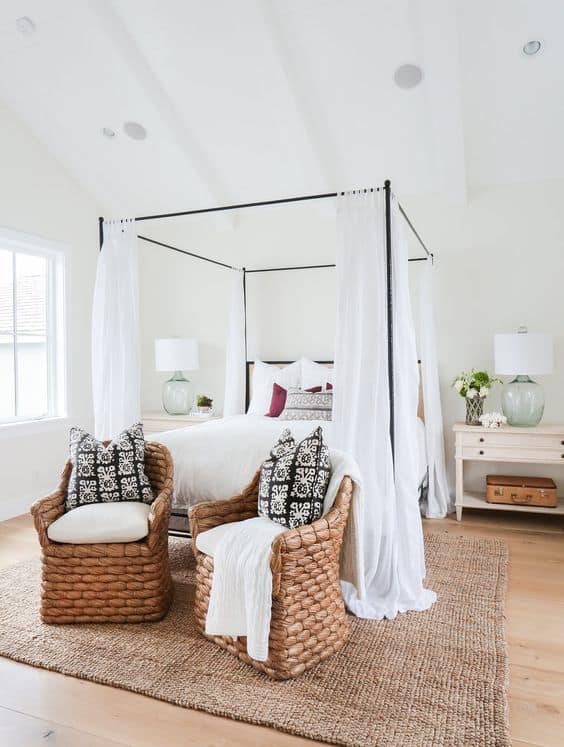
This combination works because it doesn’t ask too much of anything else in the room.
The black metal frame is graphic and clean — modern enough to sit in a contemporary bedroom without looking like a period piece. The white curtains lighten it immediately. Together they create a canopy that reads as both structured and soft, which is a harder balance to strike than it looks.
The farmhouse neutral bedroom around it — simple nightstands, muted walls — is the right setting. Nothing competes. The canopy is the room.
Airy Bedroom in Neutrals and Pastels with a Canopy Bed
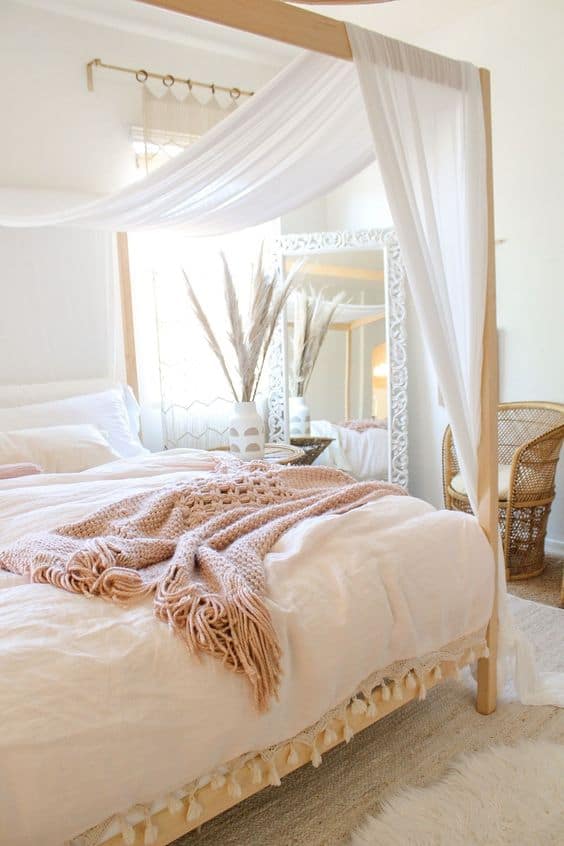
There is a version of the canopy bed that feels like a cloud. This is it.
Neutral and pastel tones, curtains that are barely there, bedding in soft chalky colors. Everything in the room seems to float slightly. It’s the easiest canopy style to live with day to day because there’s nothing heavy about it — you can have the full drama of a canopy bed without any of the darkness.
If you’re not sure whether a canopy bed is right for your bedroom, start here. It’s the gentlest possible version of the idea.
Neutral Bedroom with Canopy over the Tan Bed and Mismatching Nightstands
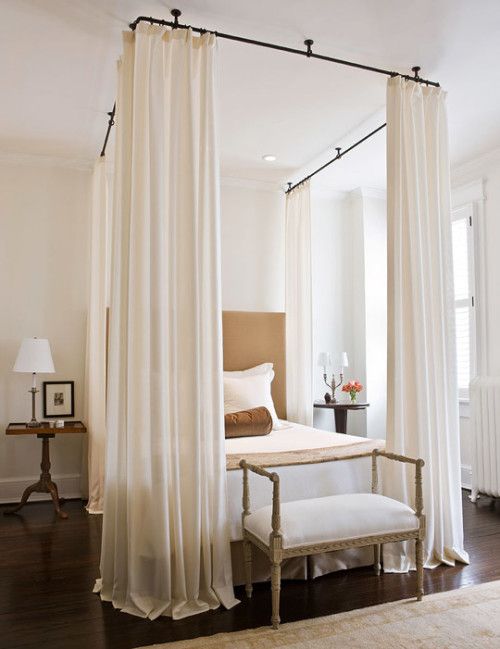
The mismatching nightstands are what I keep coming back to in this room.
They shouldn’t work. In a room this refined — a tan bed, a clean white canopy, considered neutral tones — two completely different bedside tables feel like they belong to two different decisions. And yet they’re perfect. They give the room the quality of something accumulated rather than purchased, and that quality is exactly what a canopy bed needs around it.
The canopy here is restrained: curtains that drape rather than enclose, not pulled back, not gathered, just hanging. That restraint is a design decision worth copying.
Canopy Bed with Curtains, a Bench with Pillows, and a Gallery Wall
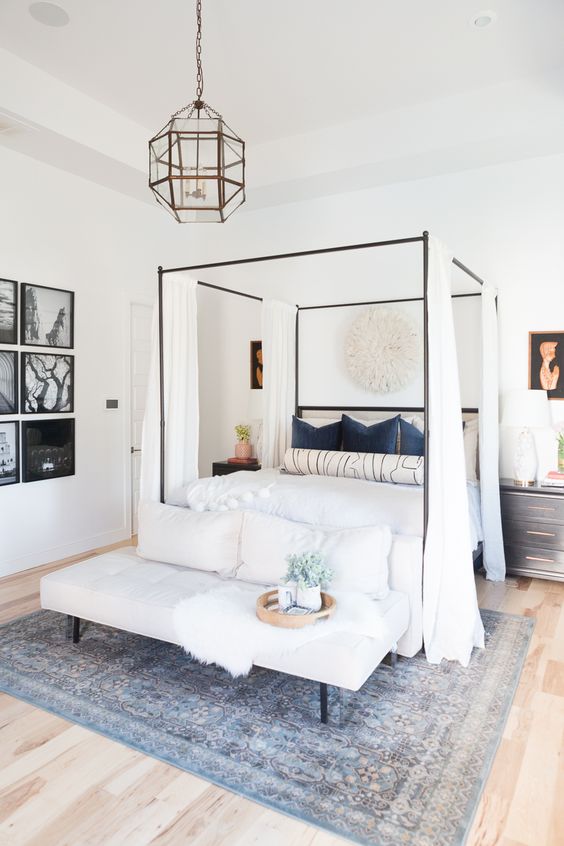
This is how you make a canopy bed feel lived in rather than just beautiful.
The bench at the foot of the bed gives the room a second seating moment — a place to sit and put shoes on, to fold laundry, to have the kind of conversation that happens at the end of the day. The gallery wall does what gallery walls always do when they work: it makes the room feel like it belongs to someone specific.
These additions tell you that the canopy is part of a bedroom that gets used, not a hotel room that gets admired.
Dark Stained Furniture and Canopy Bed with Neutral Bedding
Dark wood furniture and a canopy bed is a very particular atmosphere. Serious, quiet, deeply comfortable.
The neutral bedding is exactly right here. Dark furniture with dark bedding would be a commitment that not everyone can live with. Neutral bedding — white, cream, warm linen — lifts the palette just enough to keep the room from feeling heavy while preserving the richness that dark wood brings.
Marina has dark stained furniture in her bedroom and has been talking about adding a canopy for two years. This is the room I would send her.
Warm Brick-Walled Bedroom with a Wooden Canopy
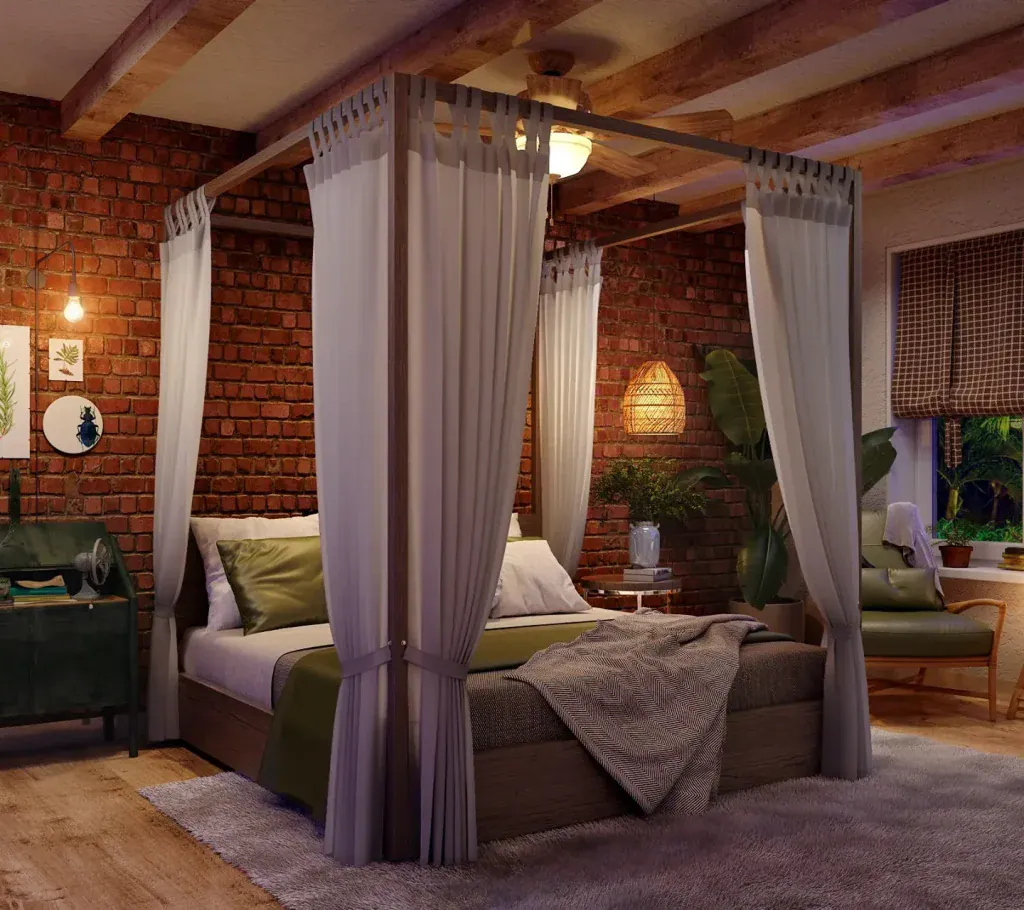
A wooden canopy in a brick-walled bedroom is the combination that should feel rustic but actually feels sophisticated.
The warmth of the brick and the warmth of the wood are in the same family, which is what makes them work together. There’s no tension between them — just a room that feels like it has been in the same building for a century and is entirely comfortable with that fact.
If you have exposed brick and have been wondering how to work with it rather than around it, a wooden canopy frame is one of the best answers.
Richly Layered Canopy Bed in Deep Blue Tones and Golden Accents
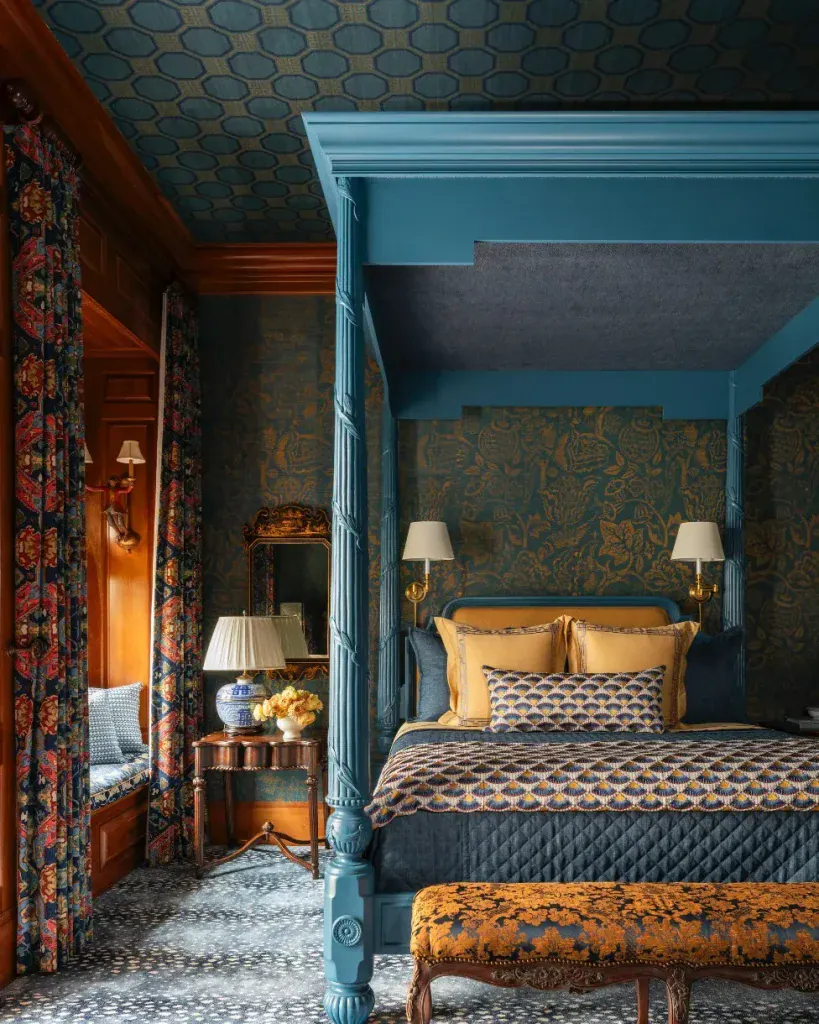
This is the dramatic version, and it doesn’t apologize for a single second.
Deep blue — navy, midnight, ink — is one of those colors that only gets richer as you add more of it. Layered in a canopy bed with cushions, throws, gathered curtains, it creates the feeling of sleeping inside something rather than simply on something. The golden accents — a lamp, a frame, hardware — are what keep it from closing in entirely.
It takes confidence to commit to this much color in a bedroom. The result is a room that feels genuinely luxurious without spending a luxury budget. Deep blue velvet costs no more than pale gray.
Pink Lace Dome Canopy
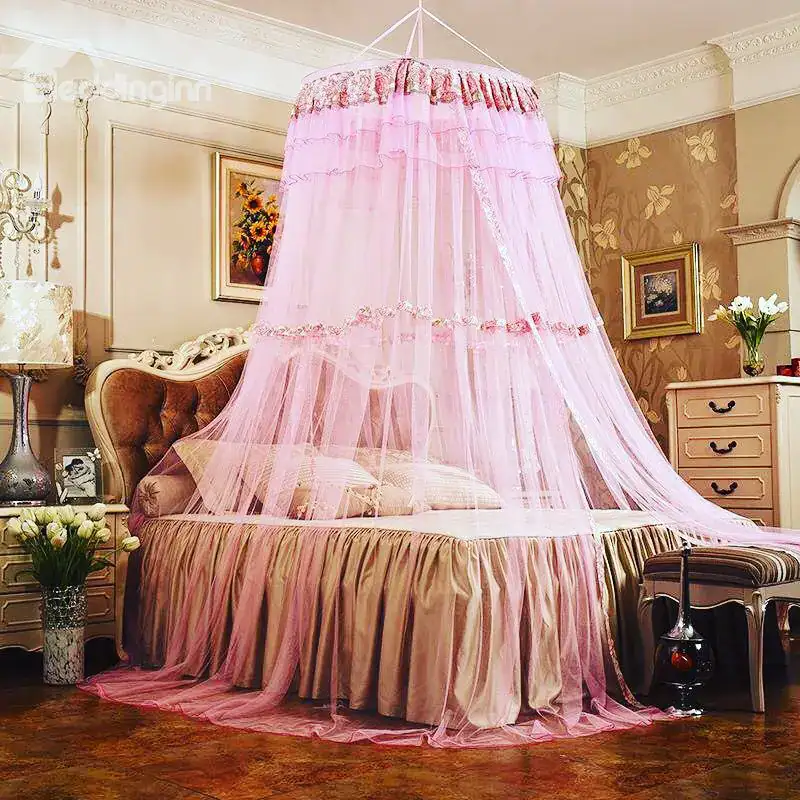
For lovers of romance and vintage flair, this pink lace dome canopy transforms the room into a soft, princess-worthy escape.
I know “princess” sounds like a dismissal. It isn’t meant to be. There’s a version of romantic femininity in interior design that gets written off as frivolous and is actually just unapologetically beautiful. A pink lace dome canopy belongs in that category. It knows exactly what it is and commits completely.
The dome shape rather than the four-poster frame changes the proportions — it floats above the bed rather than framing it, which creates a different kind of softness. It’s the most theatrical canopy option and the most personal.
🔥 Would you like to save this?
With Lights
String lights on a canopy frame are the entry point that leads people deeper into the style than they expected to go.
Soft White Drapes and Twinkling String Lights
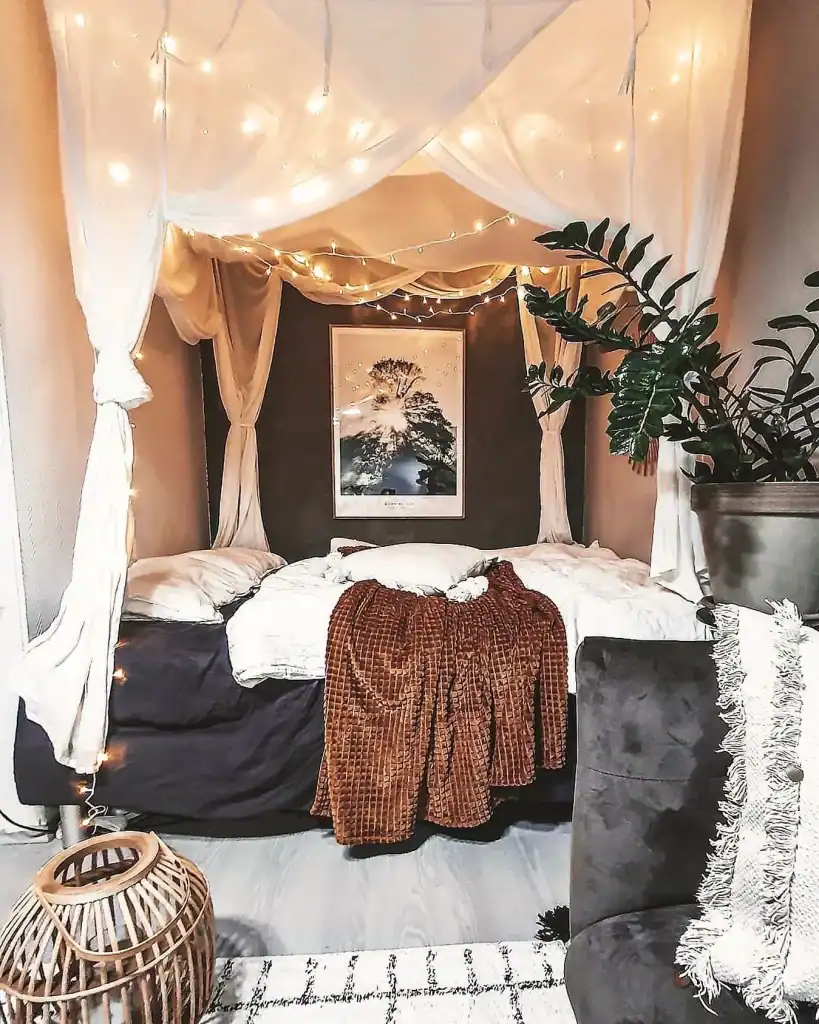
This is the version that turns your bedroom into a magical retreat.
Soft white drapes plus string lights is the simplest possible canopy treatment — no complicated hardware, no special frame, just fabric and lights looped over whatever you have. The result looks like it took hours and costs almost nothing.
What makes it work is the warmth of the light. String lights on a warm setting, not a cool white, create a glow that feels like candlelight. In a canopy this means the enclosed space above the bed becomes the best-lit part of the room after dark. You want to be in it.
Bow Window Bedroom with Black Accent Wall and Canopy Bed with Fur Branches
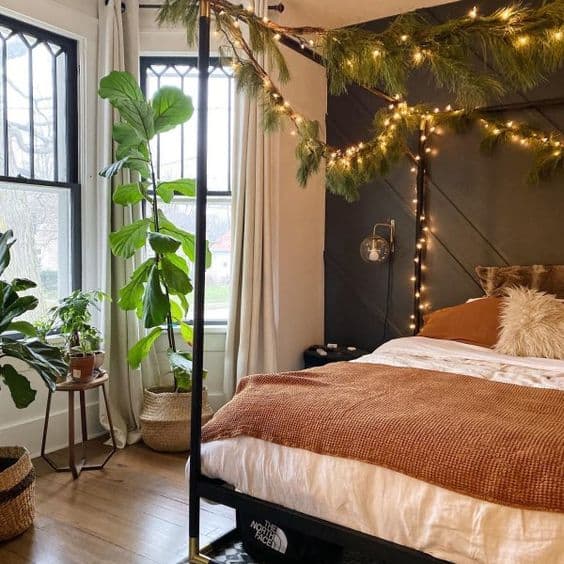
The fur branches on the canopy frame is the idea in this room that I didn’t see coming.
Dried or faux branches — curled, pale, sculptural — woven through the canopy frame create something between a botanical installation and a piece of furniture. It works because it treats the frame as a three-dimensional object rather than just a support for fabric. Add string lights and the branches cast moving shadows on the walls and ceiling.
The black accent wall grounds all of it. Without that dark backdrop, the branches and lights might read as whimsical. With it, the room feels deliberate and striking.
Modern Bedroom in Pastels with a Canopy Bed Covered with Lights and Mauve Bedding
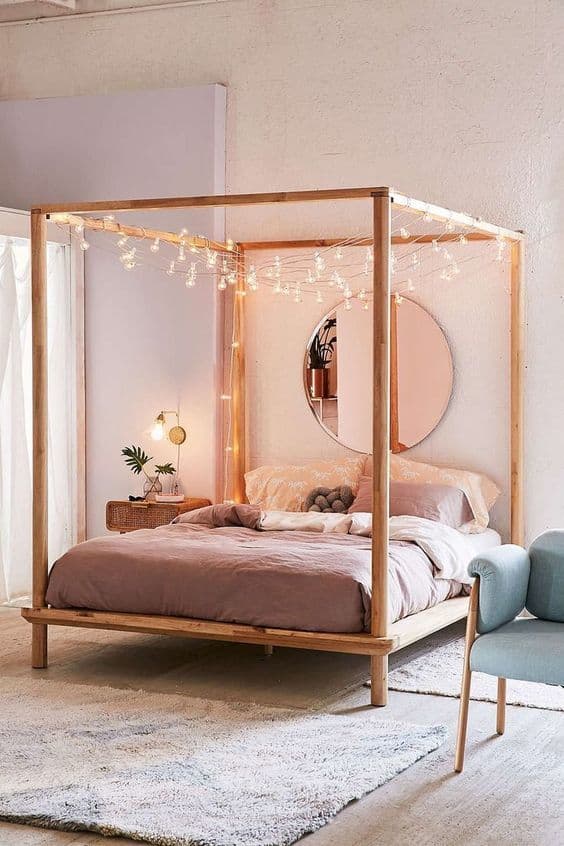
Pastels and canopy lights is the combination that photographs beautifully and lives even better.
Mauve — that particular dusty pink-purple — has a quality of light that changes through the day in a way that clearer colors don’t. In the morning it’s almost neutral. In the evening, with string lights warm overhead, it becomes the most romantic color in the room. That responsiveness to light is what makes it so right under a lit canopy.
The modern bedroom around it keeps this from being too sweet. Clean lines, simple furniture — the softness of the color and the canopy has somewhere to breathe.
Boho Bedroom with Canopy Bed, Curtains, Lights, and Wicker Pendant Lamps
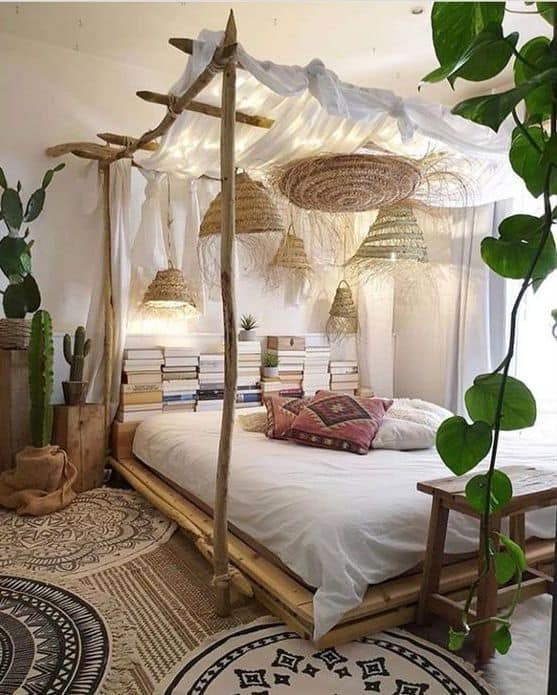
Mixing light sources is where this room does something genuinely interesting.
String lights on the canopy frame plus wicker pendant lamps at the sides plus the diffused natural light from behind sheer curtains — three completely different light sources, all warm-toned, all soft. The room never has a single bright point that draws the eye too hard. It glows evenly, from multiple directions, which is the kind of lighting that makes people want to stay in a room.
The canopy curtains here are semi-transparent, which is the right decision. Enough to define the sleeping space. Not so much that the rest of the room disappears.
Scandinavian Bedroom in Greys with a Canopy Bed Styled with Lights
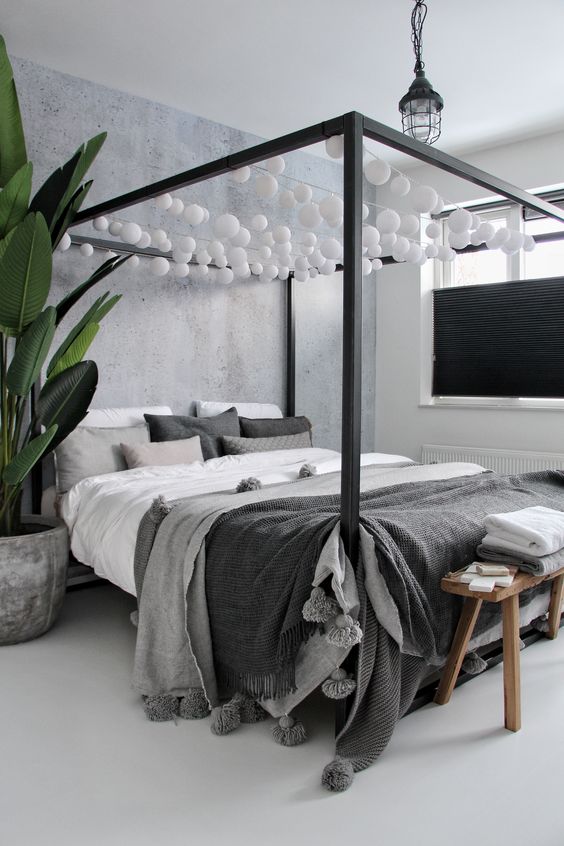
This is the minimalist case for the canopy bed, and it’s a strong one.
Grey walls, grey bedding, clean lines throughout — a bedroom that could read as cold or clinical. The canopy frame with lights looped simply over the top is the single element that makes the room feel warm. It doesn’t add pattern or color or texture. It adds light, and light is what a grey Scandinavian bedroom actually needs.
If you have been nervous about whether a canopy bed would look out of place in a minimal bedroom, this room is the answer. The frame can disappear when it needs to. Only the feeling remains.
With Botanicals
The third way to style a canopy — and the one that surprises people most — is with plants and greenery. The frame becomes a trellis.
Wooden Canopy Bed with Greenery and Macramé, Potted Cacti, and Candles
The macramé on a wooden canopy frame is where bohemian style at its best.
Macramé and wood have the same texture family — both handmade, both warm, both slightly rough. Hanging macramé from the canopy rail rather than mounting it on the wall brings the textile into the sleeping space in a way that feels intimate. Add trailing greenery and the frame starts to feel less like furniture and more like a garden structure.
The candles and cacti at the base complete it. This is a bedroom that has been built by someone with a specific vision, not assembled from a shop.
Boho Jungle Bedroom with Mid-Century Modern Furniture and Neutral Curtains
The mid-century modern furniture is the unexpected element that makes this jungle bedroom work.
Without it, floor-to-ceiling plants around a canopy bed could start to feel chaotic. The clean lines of mid-century furniture — tapered legs, simple forms — introduce an organizing principle that holds the room together. The jungle grows around the structure rather than overwhelming it.
Neutral curtains on the canopy are the right choice here. The plants provide all the color and texture the room needs. The curtains are just shape.
White Bedroom with a Canopy Bed Styled with Greenery and White Curtains
The greenery on white is one of the cleanest botanical canopy treatments.
Everything in this bedroom is white or near-white: the walls, the curtains, the bedding. The greenery on the canopy frame is the only color in the room, and because everything else has stepped back, it reads as vivid even when it’s just a handful of trailing leaves.
It’s the most understated version of the botanical canopy. The kind of room that looks effortless because someone put real thought into where the effort would show.
Bed Frame Created Out of Faux Greenery
A bed frame created out of faux greenery is a lovely idea for a person who loves botanical decor.
This is the most committed version of the botanical canopy — the frame itself becomes the plant. Faux boxwood panels, climbing vine frames, or sculpted topiary-style structures built around the bed create something closer to a garden folly than a piece of bedroom furniture.
It sounds extreme. In the right room — white walls, simple bedding, natural light — it’s extraordinary. Zina saw something like this in a magazine once and talked about it for weeks. I understood completely. Some ideas stay with you because they do something you didn’t think was possible.
The One Thing They All Have in Common
Every room in this collection — from the minimal grey Scandinavian bedroom to the fully draped deep blue enclosure — works because it committed.
A half-committed canopy bed is just a metal frame with some fabric that nobody pulled straight. The ones that work are the ones where someone decided what kind of room they wanted to wake up in and then made every decision toward that feeling.
That’s the only rule worth keeping.

I’m Katerina Lithopoulou, co-creator of DIY Cozy Living. I’ve always loved the little things that make a space feel special. With a background in language and a passion for photography and cozy design, I enjoy turning everyday inspiration into simple ideas people can actually use.
My motto: “Cozy isn’t a trend — it’s a feeling.”
